


 Francais
 Deutsch
 Italiano
Refine Your Search
+"Japan" +1944 stock footage and images
- Showing 55 to 60 of 106 results more
more Hide
Hide
Coal substitutes prepared in Japan.
Coal miners walk in field of mine. Coal miner enters into tunnel. Coal miner dugs and picks coal rock. Shovels in tunnel. Coal miners are in mining operation. Machines in factory. Coal substitutes. Miners fill the coal substitute into sack. Coal substitute is loaded in truck and shipped.
Social and economic distinctions in Japan
Japanese civilians seen working. Japanese Army and Navy stand first in social rankings, followed by Aristocratic families and political leaders whereas last in social rankings, are the civilians. Animated pictures seen. Japanese police taking civilians to prisons. Fanatic organization's leader seen. Newspaper headlines showing murder of Premier by the fanatic organization. Japanese children in classrooms. A motto reads 'Hakko Ichin'. (World War II period).
Japanese hunt deer in Nikko, Japan.
Deer hunt begins in Nikko. Japanese go for deer hunting in mountains of Nikko. They have guns with them. They hunt the deer from hidden places. Japanese hunter shoots the deer. View of field in Nikko.
U.S. Lieutenant General Daniel Sultan explains Japanese aggression in China and need for troops in India and Burma during WW2
World War II film about the China, Burma, India (CBI) Theater of Operations. A soldier is seen filling out a form seeking information about him and inviting him to write in questions about anything he hadn't learned through normal information channels. Scene shifts to Information and Education Department of the Burma-India Command, where it is being processed by a soldier. Lieutenant General Dan I. Sultan, commander of Burma-India Theater, is seen next, seated at a desk, with wall map of the region behind him. He is appearing in an information film intended to inform troops under his command. He notes that more than half the troops who filled out the information form, asked why American troops were stationed in India and Burma. He refers to the recent recall of General Stillwell and the splitting of CBI into two theaters (China and India/Burma). He states that the purpose is a path toward Japan. An animated map shows China (that narrator notes has been fighting Japan since 1937). Animation shows Japan walling off China from the outside world, by seizing her ports, and then concentrating its grip on the Eastern part of the country. Without access by sea, the allies had only one option to assist China in the fight against Japan. That was to open the Burma Road. Film shifts to scenes of Japanese bombing of Shanghai and Chinese civilians abandoning the city in 1937 during Second Sino-Japanese War. Wounded and injured Chinese fighting fires while tending casualties in an open area. Glimpse of Chinese soldiers near one of their few large artillery pieces. A gun crew manning one of her few antiaircraft guns. Chinese jam road in trek to the unoccupied provinces of the country. Chinese carrying casualties on stretchers, making do without ambulances. Chinese coping in the face of all kinds of shortages. In contrast, well supplied Japanese troops are shown in formation. Japanese troops, military vehicles and equipment are seen. Japanese firing machine guns and heavy artillery against Chinese positions. Japanese armor and long lines of troops engaged against the Chinese, who continue to resist in spite of shortages and hardship. Chinese soldiers without shoes, marching in a column.
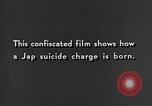
The military cadets undergo a training and graduate from the Tokyo School.
A documentary depicts the life of military personnel in Japan . A Japanese soldier on a horseback. The Tokyo School. Students enter the school. Students in a class appear for the military exam. A Japanese officer welcomes the students at the military school. The cadets stand in a squad and listen to him. A military candidate stands on the roof and gives a wake up call. Cadets get ready and move out. They perform different exercises. They practice Jiu-Jitsu. Japanese military cadets attend classes and study different subjects. They are being trained with various equipment. Cadets in a class as they prepare to give proper command. The cadets go into different schools like the cavalry,air force, engineer,artillery. They are being given training in the artillery. A pilot climbs in the cockpit and the aircraft in flight. All the cadets get graduated and a ceremony being conducted. Emperor Hirohito reviews graduates. (World War II period).
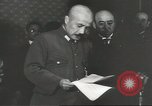
Japanese people in all walks of life supporting their war efforts in World War II
Japanese leader, Hideki Tojo addresses members of the legislature (Diet) saying their task is to set the Emperor's mind at ease. View of vast field full of Japanese soldiers performing supervised calisthenics. A kitchen preparing meals in boxes for Japanese soldiers. Soldiers hanging, one arm at a time, from a horizontal bar in a gymnasium. Radio antennas and smoke stacks are seen in Japanese industrial sites. Factory workers, all dressed alike, enter a war plant in Japan. Scientists seeking to invent new weapons of war. Japanese men and women workers in war production factories producing ammunition. Workers assembling artillery in a factory. Others building a new ship in a shipyard. Japanese boys and girls in school uniforms working on a farm. Women carrying harvested crop suspended from poles. Others threshing harvested grain and working in fields. Men and women operating Japanese fishing boats and hauling nets filled with their catches.