


 Francais
 Deutsch
 Italiano
Refine Your Search
+"Japan" +1944 stock footage and images
- Showing 67 to 72 of 106 results more
more Hide
Hide
United States aircraft strafe aircraft, shore installations and gun emplacements in Okinawa, Japan during World War II.
Strafing attack on Japanese aircraft, shore installations and gun emplacements by U.S. aircraft during World War II. A Japanese float plane shot at and catches fire during night. Japanese Betty and bomber aircraft and a Sampan ship under attack. Strafing shore installations and gun emplacements in Okinawa. A Japanese single engine fighter plane turning over on its back. A strafing attack on houses and a bridge over a small stream.
Japanese atrocities against Chinese people; burning Chinese cities; U.S. war bonds fund weaponry in fight against Japan.
U.S. propaganda film during World War 2 aimed at spurring investment in U.S. War Bonds. Narrator opens and closes film asking audience "Have you killed a Jap today?" Scenes of American workers at munitions and ware equipment factories. Images (some real footage and some staged) of Japanese soldiers murdering Chinese civilians, bombing and burning Chinese cities, burying Chinese civilians alive, and executing Chinese civilians and American soldiers. Bodies of Chinese dead being loaded into trucks. Narrator explains that investment in U.S. War Bonds, fueling manufacture of armament and war supplies can bring justice against Japanese atrocities and kill Japanese soldiers. American people working in factories. Iron being forged. Workers work at factory machines. They shovel coal into a combustion chamber. Skyline views of San Francisco, Chicago, Pittsburgh and New York. U.S. War Bond for $100 is shown. American tanks, trucks, shells, airplanes and guns used to fight Japanese soldiers. Views of dead Japanese soldiers lying on the ground and on screen messaging, "Every War Bond kills a Jap!" encouraging Americans to buy war bonds in bond drive number 6.
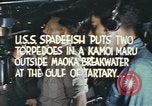
Interior of Submarine USS Spadefish while launching torpedoes during World War II
Interior of the USS Spadefish (SS-411) in the Sea of Japan, during World War 2, as the Captain looks through the periscope. Slate states "U.S.S. Spadefish puts two torpedoes in a Kamoi Maru outside Makoa Breakwater at the Gulf of Tartary." The Captain (a Navy commander) lowers the periscope and issues instructions to the crew.The Captain, back at the periscope, while a Lieutenant stands nearby holding a watch and apparently marking time. The Captain lowers the periscope.
Military officers and leaders at a meeting of the Axis powers in Hungary.
Main building of University of Debrecen, in Debrecen, Hungary, with lake area in front of the entrance. Flags of the German Reich, Empire of Greater Japan, Kingdom of Italy and other Axis powers fluttering outside the building. Axis leaders and military officials inside the building. Dignitaries and Military officials seated on a stage in an auditorium. A large crowd seated to attend the function. (World War II period).
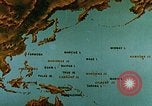
U.S. and Japanese Naval aircraft in aerial combat over the island of Kwajalein in the Pacific Theater during World War II.
The USS Yorktown (CV-10) in the Pacific Theater during World War II. Map of Marcus Island and surrounding islands in Japan. Animation depicts the U.S. fleet's aim to recapture the Philippines and land on the main land of Asia to help their ally China. USS Yorktown underway. A map depicts its advance towards its target of Kwajalein Island in the Marshall Islands. Imperial Japanese Navy Air Service Mitsubishi A6M Zero fighters in flight. U.S. planes in dogfights with Japanese aircraft over Kwajalein Island. Aerial gun camera footage shows United States aircraft attacking Japanese aircraft. Japanese airplane is hit and explodes. Another Japanese airplane falling from sky to crash in water. Heavy bombardment and strafing on land of enemy targets, wrecked aircraft. Black smoke rises from explosions on the burning island. Heavy shelling by surface ships. Assault crafts filled with U.S. Marines and Army soldiers hit the beaches on Kwajalein. U.S. airplanes in flight over the island.
Speaking from the NY State Capitol, Governor Thomas Dewey hails the Liberation of Paris by the Allied forces in World War II.
New York Governor Thomas E. Dewey hails the Liberation of Paris by the Allied forces. The New York State Capitol building (State St. and, Washington Ave, Albany, NY 12224, United States) in Albany, New York. Governor Dewey addresses the nation regarding the Liberation of Paris in World War II. He states that the incident is an inspiration to others still under the Nazi German occupation. He talks about the contribution of Allied forces to the cause, America's war efforts and the goal to defeat Germany and Japan.