


 Francais
 Deutsch
 Italiano
Refine Your Search
+"Japan" +1945 stock footage and images
- Showing 25 to 30 of 1093 results more
more Hide
Hide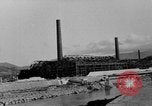
Damaged Mitsubishi steel and arms plants in Nagasaki, Japan due to atomic bomb attack.
Damage in Nagasaki, Japan after the atomic bomb attack in August 1945. Damaged Mitsubishi steel and arms plants in Nagasaki. Damaged steel frames of the factory whereas concrete walls stay unharmed. Smoke stacks also stand unharmed at the factory site. Pushed in steel frames due to directional force of the blast. Rumbled over head cranes. Damaged artillery and aircraft guns. Homes at the factory area. Damaged equipment and machinery. (World War II period).
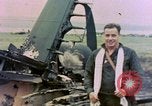
U.S. Navy fliers examine wreckage of FG-1D Corsair airplane, at the Omura airfield in Nagasaki, Japan, after World War II.
U.S. Navy flyers at the Omura Air Field in Nagasaki, Japan after the end of World War 2. They poke around the wreckage of a U.S. Navy Corsair(FG-1D Corsair BuNo.88056 flown by Lt.Col. D.K. Yost of MAG-51, US Navy, lost on 11 September, 1945.) They are accompanied by a Sergeant, carrying a long handle axe that he jokingly swings a couple of times at the fuselage of the Corsair. Camera shows numerous Japanese military airplanes parked randomly on the grass field.
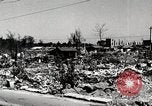
Demolished Warehouse in Shiba District of Tokyo Japan, soon after end of World War 2
Demolished warehouse in Shiba district, Minato Ward, Tokyo, Japan. B-29 in flight to the ruins of Shiba district. Bomb damage and devastation from aerial bombardment in World War II. Damaged Buddhist club. Demolished residential district.13 September 1945.
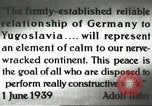
Tripartite Pact signed by Germany, Italy and Japan in Berlin, Germany. Ensuing attacks by Germany and Japan in World War II
This film is a scattering montage of World War 2 scenes from 1939 through 1945. Part of an agreement between Nazi Germany and Yugoslavia is shown in English. It is dated June 1, 1939 and ostensibly signed by Adolf Hitler. Next, German Ju 87, Stuka dive bomber aircraft are shown peeling off from formation, on April 6, 1941, to attack Yugoslavia. Bombs bursting on the ground. Closeup of a Stuka airplane in a dive, making its characteristic whine, and dropping bombs. Bombs exploding just outside some concrete walls. German infantry running along railroad tracks and entering backyard of house in a village. German soldiers observing from overlooking hill; climbing over rubble; and marching along a road toward a village. Animated map showing German invasion areas early in World War II, extending through most of Europe and into Norway, by 1941. Animated map shows further invasions into France, Belgium, low countries, the Balkans, and Eastern front towards the Soviet Union. Map highlights Tokyo, Rome, and Berlin. Delegations walking in hall of Reich Chancellery in Berlin, to sign Tripartite pact, on September 27, 1940. The group is led by by Count Galeazzo Ciano (Italian Foreign Minister, and Mussolini's son-in-law); Joachim von Ribbentrop, Germany's Foreign Minister and Japan’s Ambassador Saburō Kurusu. The diplomats are seen, next, standing near a table as Adolf Hitler enters rendering Nazi salute. He shakes hands with Count Ciano and Ambassador Kurusu. Hitler is seated to watch the proceedings. Von Ribbontrop is seen signing for Germany. Next scenes show German armored units heading East in Operation Barbarossa (June of 1941). A sign identifies the town of Eydtkau (Eydtkuhnen) on the German-Lithuanian border. German armor and artillery moving eastward. German troops destroying international crossing barriers. German troops firing siege guns. Montage with glimpses of German battle scenes showing tanks, guns, rockets in action with attendant explosions, fires, and destruction. Formations of German warplanes in flight, including Junkers Ju-52s that carry troops, including paratroops. View from above of Junkers Ju-87 Stuka dive bombers in formation. Battle of Britain scenes, with view of St. Paul's Cathedral in London, England (which miraculously survived the Blitz). The Tower Bridge in London, seen through a haze following blitzkrieg. German Junkers 87 Stuka dive bombers peeling off from formation to attack. British anti-aircraft searchlights shining beams skyward. Diving bombers illuminated by the lights. Anti-aircraft guns firing. Nighttime scenes showing gunfire flashes, explosions, tracer bullets and fires in London. British fire brigades fighting fires in London buildings as some collapse from the German bombing during the so-called "Blitz." Scene shifts to Pearl Harbor, December 7, 1941, as a Japanese bomb explodes on a U.S. Navy warship. The USS Arizona billowing smoke and listing as it succumbs to Japanese bombing. Another view of the Arizona sinking. Smoke rising from Battleship Row, at Pearl Harbor. Glimpse of postwar Nuremberg trial.
Operation of United States Coast Guard in Okinawa and Iwo Jima, Pacific Theater during World War II
Overseas activities of United States Coast Guard in World War 2. February 19, 1945, U.S. Marines invade Iwo Jima in Pacific Theater. Naval guns and aircraft bombard Iwo Jima. Mountain in the background. Aircraft in flight. Marines and Coast Guardsmen aboard landing craft. Marines landing on Iwo Jima under heavy Japanese fire. Destroyed landing ships litter water's edge. Marines hunkered down and treating wounded, under fire. LSTs and other ships at established beachhead. Vehicles drive onto beach. April 1, 1945, Marines attack Okinawa. Navy warships bombard Okinawa with heavy guns and continuous rocket fire. Beachhead is established against light resistance. Japanese kamikaze aircraft attack American invasion ships. Several ships are hit and sunk. Surviving sailors are helped aboard rescue boats. Antiaircraft fire from American ships fills sky with smoke and flak. A kamikaze aircraft crashes in the sea. Sky filled with American bombers. Aerial view of Atomic bomb explosion over Nagasaki Japan on August 9, 1945. Raising American Flag on Japan homeland.
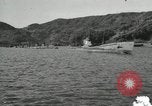
Operation "Road's End" and preparations for destruction of the Japanese submarine fleet moored in Sasebo Bay, Japan
Views from U.S. boat moving among Japanese submarines in Sasebo Bay, Japan, during Operation Road's End, involving the scuttling of the Japanese submarine fleet. Seen are submarines: I-47; I-162; I-156l;n-203;I-158;I-103;107;I-58. An American launch pulls up to I-58 (the sub that sank the USs Indianapolis on July 31, 1945, in the Philippine Sea).Vice-Admiral Robert M. Griffin, Commander of U.S. Naval Forces, Japan, climbs aboard the sub, followed by other members of his party. Admiral Griffin walks the deck of the submarine, followed by a Rear Admiral, who points out some features of the boat to Admiral Griffith. View of the group standing on the deck of the I-58.