


 Francais
 Deutsch
 Italiano
Refine Your Search
+"United States" +1945 stock footage and images
- Showing 103 to 108 of 2149 results more
more Hide
Hide
Officer paints nose art on B-29 bomber Deaner Boy of U.S. Army Air Force at their base on Tinian, Mariana Islands during World War II
United States Army Air Force crew at their base in the Tinian, Mariana Islands during World War II. A Army Air Force officer stands on a hoist near the cockpit of a B-29 bomber paints a picture on it. Picture of a baby wearing boxing gloves. Officer paints the baby's diaper with white paint. Soldier looks at nose art painting on the B-29 nose with written wording "Deaner Boy" on it. Another soldier walks up and looks at the nose art painting. (Note: Painter might be Lieutenant Dean C. Forburger, based on examination of image reflected back from aircraft body. Forburger was a B-29 pilot stationed at Tinian at the time, and images exist of him standing beneath this nose art. Forburger was not a member of the crew on Deaner Boy when it perished in a mid-air collision accident in February 1945. The Deaner Boy nose art was painted at least twice on this aircraft, as there are also other images of it in existence with a side-facing baby and cursive lettering for "Deaner Boy").
U.S. orientation film for Allied occupation forces, to provide background for understanding Japanese and their society
Background information for United States occupation forces in Japan after end of World War II. At start, the film shows sky filled with U.S. Navy airplanes flying in formations. They include Vought F4U Corsair aircraft, among others, and are seen overhead above the Battleship USS Missouri (BBB-63). Closeup of the USS Missouri with her crew in formation on deck wearing dress whites. Next, General Douglas MacArthur is seen and heard speaking from a podium on the Missouri's deck. He invites the representatives of the Emperor of Japan, and the Japanese Government, and the Japanese Imperial headquarters, to sign the instrument of surrender. The date is September 2, 1945, just after the end of World War 2. Closeups of the Japanese delegation, which includes envoys Foreign Minister Mamora Shigemitsu and General Yoshijiro Umezu, and of MacArthur. Japanese Foreign Minister Mamora Shigemitsu sits at a table. Closeups of him signing the surrender document. Change of scene to Japan, where camera pans over many thousands of Japanese people assembled to learn of their fate. Closeups of Japanese soldiers and family members, as Narrator asks how should the U.S. occupying force treat them. View of soldiers in plain non-military uniforms. Views of Japanese responding en masse to a leader, during World War 2. Views of child victims of the war. Closeup of Japanese soldier firing a short barrel light machine gun. Views of Japanese pedestrians including families, most in western dress. Japanese workers in an office. Film shows artists view of one worker's brain, and then many brains, as Narrator refers to need for reorienting Japanese thinking. View of learned wise Japanese leader at a podium. View of a Japanese soldier posed with his sword above the head of a war prisoner. Japanese mother feeding her baby. Closeups of Japanese babies. Closeups of Japanese school age children, in a group, and some doing things in school, and some at a playground. Group of uniformed Japanese students studying the art of Japanese calligraphy. Students doing artwork, studying nature outdoors, and paying attention to a teacher using a black board to explain how to calculate volumes of different shaped vessels. Students in classes of Geography and of geology. Japanese chemists, architects, and lawyers at work. Telephone switchboard operators at work. Electrified train moving on a track.
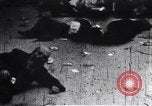
Atrocities committed by Nazis against Jews in Germany, submitted as evidence "Exhibit USA-280" during the Nuremberg Trials
Portions of a damaged film. Excerpted from original shown during the Nuremburg trials and submitted as "Exhibit USA 280." Nuremberg trial transcripts of 13 December, 1945 include the following excerpted descriptions of the footage spoken by U.S. Commander William J. Donovan: "This is a strip of motion pictures taken, we believe, by a member of the S.S., and captured by the United States military forces in an S.S. barracks near Augsburg, Germany...We have not been able to establish beyond doubt in which area these films were made...The film offers undeniable evidence, made by Germans themselves, of almost incredible brutality to Jewish people in the custody of the Nazis, including German military units. It is believed by the prosecution that the scene is the extermination of a ghetto by Gestapo agents, assisted by military units...This film was made on an eight millimetre home camera...The pictures obviously were taken by an amateur photographer...it is burned...This is a silent film....I wish to...direct the Tribunal's attention to certain of the scenes. Scene 2: A naked girl running across the courtyard. Scene 3: An older woman being pushed past the camera, and a man in S.S. uniform standing at the right of the scene. Scene 5: A man with a skull-cap and a woman are manhandled. Scene 14: A half naked woman runs out of the crowd. Scene 15: Another half-naked woman runs through the house. Scene 16: Two men drag an old man out. Scene 18: A man in German military uniform, with his back to the camera, watches. Scene 24: A general shot of the street, showing fallen bodies and naked women running. Scene 32: A shot of the street, showing five fallen bodies. Scene 37: A man with a bleeding head is hit again. Scene 39: A soldier in German military uniform, with a rifle, stands by as a crowd concentrates on a man coming out of the house. Scene 44: A soldier with a rifle, in German military uniform, walks past a woman clinging to a torn blouse. Scene 45: A woman is dragged by her hair across the street.
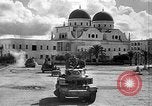
UN Commissioner Adrian Pelt and members of an Advisory Council meet people and the Emir of Cyrenaica in Libya.
A film depicts steps in Libyan independence. Allied soldiers on tanks during World War II. A tank goes past a ruined building. People gathered look as the Union Jack is unfurled. People read a proclamation pasted on a wall. Ruins of World War II. A meeting in the United Nations in 1945 where it is suggested that Libya be placed under temporary UN trusteeship. A resolution in the UN on 21st November, 1949 to create an independent Libya. The Russian delegate to the UN states his disagreement. The United Kingdom delegate speaks in favor of the resolution. A UN aircraft lands and taxis in Libya. Advisory Council members, led by Mustafa Qasim Mizran, who is first to exit the plane and is head of the National Party and Director of the School of Arts and Trades in Tripoli, are joined by UN Commissioner in Libya Adrian Pelt as they are greeted by dignitaries. The headquarters of the Commissioner and the Advisory Council in Tripoli. A sign reads 'Office of the United Nations Commissioner in Libya'. Members of the Advisory Council include representatives from Tripolitania, Cyrenaica, Fezzan, Egypt, France, Italy, Pakistan, the United Kingdom, the United States and a minority group delegate. Cars carrying the representatives drive out of the gates of the headquarters. They meet people to become aware of their problems. People greet the UN Commissioner and the members of the Advisory Council. A visit to Benghazi where they meet the Emir of Cyrenaica. People holding placards in front of the Emir's palace to greet the Advisory Council. They meet the Emir, who is the religious Muslim leader, in his place. The headquarters of the Commissioner and the Advisory Council, where Mustafa Qasim Mizran is seen touching his face, as he stands behind king Idris,

Japanese bombers bomb a Chinese cities, including Shanghai, and infantry advance during Second Sino-Japanese War (WW2)
A 1945 film titled 'The Enemy Japan Dream of Empire' details Japanese conquests starting with China during Second Sino-Japanese War in 1937. United States Ambassador to Japan Joseph C. Grew speaks about the ruthless nature of Japanese. Wall maps in the background. Aerial formation of Japanese bombers over a Chinese city, possibly Shanghai, during Second Sino-Japanese War (World War II), 1937. Smoke billows up from bomb bursts. Dead bodies of civilians on bombed streets. View of damaged Palace Hotel in Shanghai. Japanese infantry and horse-drawn munitions carts advance into the city. Car pulls up in front of building in Japan and a guard opens door. Japanese military leaders exit car. View of many tall banners with Japanese rising sun symbol hanging from ceiling. Japanese statesmen and army Generals confer in Japan.
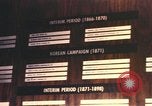
Hall of Heroes at the Pentagon showing hero names from Korean Campaign to the Vietnam War
View of the Hall of Heroes at the Pentagon, in the United States, during the Vietnam War. Names of the war heroes in the hall. Nameplates of the war heroes of each historical conflict on the wall. Names of the soldiers and officers who served the best in the wars. Names under the nameplates reading: 'Interim Period (1866-1870)', 'Korean Campaign (1871)', 'Interim Period (1871-1898)'. Other nameplates read: 'War with Spain (1898)', 'Philippine insurrection (1899-1913)', 'China Relief Expedition-Boxer Rebellion (1900)'. Several other conflicts mentioned in the hall. Other nameplates read: 'World War I (1917-1918)', 'Haitian Campaign (1919-1920), 'Second Nicaraguan Campaign (1925)', 'Word War II (1941-1945) and 'Vietnam (1964-Present).