


 Francais
 Deutsch
 Italiano

Refine Your Search
+"United States" +1945 stock footage and images
- Showing 109 to 114 of 4253 results more
 Hide
Color Sound
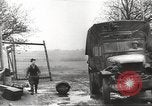
U.S. 4th Armored Division Commander Col. Hayden Sears forces German civilians to visit the Ohrdruf Concentration Camp in Germany (WW2)
The liberation of the first Nazi concentration camp Ohrdruf near the end of World War II. On April 6, 1945, troops from U.S. Combat Command A, 4th Armored Division, commanded by Colonel Hayden Sears forced local town's people to tour the camp. Captured Nazi German officials get out of an army truck. A German Major (Doctor) also accompanies the group. Dead bodies on ground. Nazi officials are forced to watch heaps of bodies found inside a room. Burned bodies of Polish, Czechoslovakian, Russian, German Jews and political prisoners. The policy of requiring local German officials to view every captured concentration camp began with this episode. The rationale was the "They will never be able to say they didn't know what happened here." (Col Sears as reported by his son.)
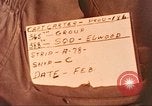
United States Army Air Force 365th Fighter Group strafe German held positions during World War II.
United States Army Air Force 365th Fighter Group over German held targets in February 1945. Aerial view of smoke rising from bombed buildings on the ground. View of green fields. A bomb damaged building.
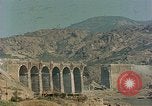
Aftermath of World War II. A wrecked bridge and abandoned United States Army gliders in France.
Reminders of World War 2, in France, 1945. A high bridge of about eight masonry arches with two bombed out, in mountainous region of France. Camera pans right, showing a number of substantial homes scattered across the valley, with tall mountains behind. Scene shifts to a different, flatter landscape, where about a dozen U.S. Waco CG-4A gliders are seen abandoned in a field, in various states of disrepair. Writing in chalk on the side of one glider reads, "Whispering Yoddles, Fort Worth Texas, Little One Alice". There are no D-day stripes on these gliders, indicating they were probably used subsequent to the Normandy invasion, in other operations such as "Bluebird & Dove" in the South of France, in August, 1944.
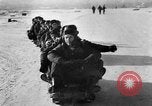
U.S. Army Air Forces operations at Juvincourt Airfield, France, during World War II.
Operations of the U.S. Army Air Forces 394th Fighter Squadron, 367th Fighter Group, at Juvincourt Airfield (Advanced Landing Ground A-68) in France, during Winter of 1944, World War 2. The entire field is covered in snow. Pilots ride to their P-38 aircraft on a train of sleds, pulled by a Carl Eliason Motor Toboggan (Made by Four Wheel Drive Auto Company of Clintonville, Wisconsin). Pilots playfully brush some snow toward the camera as they pass. They stop to let a pilot off at his P-38 (reportedly the pilot is Jack Hallett). Next, P-38 aircraft are seen taxiing for takeoff over the snow, and then, flying very low over the field. The sound of gunfire is heard in the background. An abandoned (crash-landed) RAF Avro Lancaster bomber is seen collapsed on its left wing and elevator, in the snow. (It has been suggested that this might be Lancaster serial no ME850 LS-D of XV squadron RAF that crash landed on January 1st, 1945 or Lancaster VN-G of 50 SQN that crashed there on the same day.)

Trinity test - the first ever Atomic bomb tested in Alamogordo New Mexico, United States.
Shows the first atomic bomb explosion in history, on July 16, 1945, resulting from the work of the Manhattan Project. Atomic bomb tested at an experimental station in New Mexico, United States. Bomb explodes and a mushroom cloud forms, seen from cameras 6 miles away. Smoke and fire emerges. (World War II period).
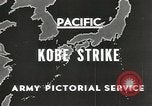
United States B-29 bombers drop incendiary bombs over Kobe, Japan
"Kobe strike" shows United States B-29 bomber aicraft dropping 3200 tons of incendiary bombs over industrial targets in Kobe, Japan during World War 2. Firebombing causes pillars of smoke to rise up. Narrator speaks of strikes on other Japanese cities also and relates statement by General Arnold that beginning July 1945, industrial Japan will be hit by bombs at the rate of 2 million tons per year, or 5480 tons per day, adding that "by the end of 1946, Japan will have ceased to exist as a bombing target."
CRITICALPAST.COM: About Us | Contact Us | FAQs - How to Order | License Agreement | My Account | My Lightboxes | Shopping Cart | Advanced Search | Featured Collections | Website Terms & Conditions | Privacy Policy ©2026 CriticalPast LLC.
License Agreement |
Terms & Conditions |
Privacy Policy
©2026 CriticalPast LLC.