


 Francais
 Deutsch
 Italiano

Refine Your Search
+"United States" +1945 stock footage and images
- Showing 115 to 120 of 4253 results more
 Hide
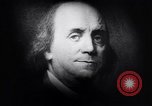
Ground Infantry quiz question on the famous speech by President Harry S Truman in United States
Picture of Benjamin Franklin, Photo of President Franklin D Roosevelt, President Abraham Lincoln, President Harry S Truman, Prime Minister of Britain Winston Churchill and Premiere of Soviet Union Joseph Stalin. GI quiz question on the famous speech by President Harry S Truman. President Harry S Truman addresses United Nations Council on April 25, 1945 at the group's opening conference in San Francisco, California. Truman says, "If we do not want to die together in war, we must learn to live together in peace."
Eisenhower as the Supreme Commander of the North Atlantic Treaty Organization (NATO) and as the President of the Columbia University
Highlights the military career of U.S. General Dwight D Eisenhower from 1945 to 1952. Depicts notable World War II scenes and events starting on D-Day as Allied Forces invade France. Allied planes drop bombs on the enemy positions. Allied troops in Higgins boats land on the beaches of Normandy France. U.S. tanks move forward. Allied soldiers advance towards Saint Lo. Battle in St Lo area. General Patton Forces move forward. French troops and the soldiers of the U.S. 5th Corps march through Paris. The civilians cheer. Allied soldiers move towards the German border fighting on their way. Battle of the Bulge - when the Germans turned counter offensive. The bridge at Remagen on the river Rhine. Allied troops cross the bridge. Allied troops on the offensive, west of the Rhine. The enemy surrenders. Rubble on the streets. General Eisenhower with the troops. Military officers sign documents of German surrender on May 7 1945 in Reims at SHAEF headquarters. Eisenhower makes a speech at the end of the war. Eisenhower, in Paris, waves at the people from an open carriage. People welcome him in his homeland with a ticker tape parade in New York City. Eisenhower waves at the people gathered at the side of the streets from an open car of a motorcade. Eisenhower swears in as the 1st post war Chief of Staff of the U.S. Army. He visited troops in various parts of the world. He salutes and moves towards a car with his wife as he leaves active military life. Pictures of Eisenhower as he becomes the president of the Columbia University. He reviews the troops as he becomes the Supreme Commander of the North Atlantic Treaty Organization (NATO). Eisenhower on European soil. He enters a car. He assumes supreme command of the land, the sea and the air force. Against the threat from the USSR he prepares the European Armies. Soldiers enter into a train. He reviews troops. General Eisenhower and General Matthew Ridgway salute. He enters into a plane with his wife. Painting of Eisenhower being sworn in as President of the United States. Eisenhower Library in Abilene, Kansas, two boys leaving the Library.
City views of San Francisco; United Nations Conference on International Organization held in San Francisco, California (WW2)
A documentary on The United Nations Conference on International Organization that continued from April 25, 1945 to June 26, 1945 in San Francisco. A plane in flight and ships are seen in San Francisco Bay. 1940s San Francisco city views: Aerial views of Golden Gate Bridge. People on streets on San Francisco, with streetcars, buildings, pedestrians, and mid 1940's cars seen. Aircraft parked at a USAF Base as delegates from 50 countries arrive. Delegates like Jan Christian Smuts from South Africa, Vyacheslav Molotov from Russia, U.S. secretary of State Edward Stettinius arrive in San Francisco. Delegates register for the conference. United States flag on a building. Interior of the War Memorial Opera House serving as the initial meeting hall. Delegates seated. U.S. President Harry S. Truman addressing the general assembly remotely, as delegates listen through radio speakers in the opera house. Narrator recalls words of Franklin Roosevelt and recorded audio of Roosevelt is heard where he urges continuation of the work first begun by the defunct League of Nations. View of various working committees and smaller groups of the organization meeting during the Spring of 1945. Representatives debate and review concepts initiated at the Dumbarton Oaks conference in Washington DC in 1944 during World War II. Delegates addressing those assembled and signing documents that create the United Nations.
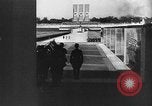
Nazi Party ceremonial grandeur is contrasted to the horrors perpetrated under the 3rd Reich
6th Nazi Party Congress at Nuremberg, in 1934, featuring a "Totenehrung" ceremony, honouring dead. Nazi SA ( Sturmabteilung) and SS (Schutzstaffel) troops in precise formations fill the Zeppelin Field Luitpold Arena, leaving only a wide pathway to the Ehrenhalle war memorial. View from behind honor guard standing at the Ahrenhalle, as Adolf Hitler, flanked by SS leader, Heinrich Himmler (in Black) and Viktor Lutze, head of the Sturmabteilung (SA), approach. Three huge banners with swastikas are seen in the far background. Scene shifts to 1945. American troops are now assembled at the main grandstand (Ehrentribüne) of Zeppelin Field. The American flag covers the wreathed swastika sculpture at the top of the Grandstand. View of German soldiers, who have been mustered out, mingling with civilians in a town. Some speak with an American soldier, who is part of the U.S. occupying force. Scene shifts to the Yalta conference in February, 1945. Winston Churchill, Franklin D. Roosevelt, and Joseph Stalin are seen seated while their most senior military staff members stand in the background. Allied leaders sit around a large conference table. U.S. Secretary of State James F. Byrnes, sits near Prime Minister Winston Churchill. Scene shifts back to Nazi era. Joseph Goebbels, Reichminister of Propaganda is speaking and haranguing a crowd. In contrast, German soldiers are seen conversing with occupying American soldiers. This is contrasted with more scenes of Nazi leaders giving impassioned speeches to a hall filled with Nazi faithful. German soldiers, prisoners of war are seen directed by U.S. military police, behind a barbed wire enclosure. Large numbers of German prisoners of war in an open holding area. Closeups of some. Bucolic scenes of farmers working in fields and herds of sheep and cattle. Hitler speaking in a forceful, animated way and haranguing an audience of rapt listeners. German civilians standing quietly in a group. (Narrator refers them being the people of Beethoven, Goethe, and Martin Luther, as statues of those iconic Germans are shown.) In dramatic contrast, numerous dead bodies of victims are being shown to German citizens by American troops, at Nordhausen, Buchenwald, and Bergen-Belsen concentration camps. This is contrasted against views of German people folk dancing in traditional costumes, German contributions to science (view of Albert Einstein speaking) and industry (view of professional glass blowers at work). Glaring contrast shows German civilians moving the body of a concentration camp victim; several civilians being shot dead by a firing squad (unseen); Rudolf Himmler; and an image Germany being destroyed, as result of the Nazis. American soldiers are loosely assembled in an open field. by the Elbe River at Torgau, Germany on 26 April 1945. American and Russian officers greet each other at the site, where their armies have met in World War 2. American and Russian soldiers mingle and greet one another. Views of Allied forces entering Germany. Another scene of victims' bodies stacked at a concentration camp. French soldiers examine stake where prisoners were tied and executed in the Gestapo headquarters on Paris France. Other views of the Gestapo prison, where victims were buried. Examples of torture devices used to coerce information from prisoners. More views of stacked bodies of victims. Germans carrying bodies from a concentration camp. General Dwight Eisenhower and General George Patton visiting the Ohrdruf Concentration Camp. Burned remains of victims. Closeup of General Patton. German officials and citizens confronting horror as they are compelled to walk through the camp. A huge wagon loaded with bodies of the dead. German women appalled and repelled by the sights. Countless numbers of dead victims covering a large courtyard. German citizens compelled to carry body of a victim from the yard. Others carrying bodies of victims. Large numbers of German citizens, seemingly shamed and remorseful at the revelations. A group of German men carrying shovels and others carrying crosses to commence burying the victims appropriately. Men carrying victims bodies in open wooden caskets along a road lined with spectators. Coffins of victims laid out in a cemetery. (Narrator alludes to them never forgetting.) German men gently place covered coffins in a long mass grave.
Civilians place burned bodies of Gardelegen massacre victims on stretchers and carry them to burial grounds in Gardelegen, Germany.
Mass burial at the site of the Gardelegen massacre, in Gardelegen, Germany, late in World War II. View of the barn on the Isenschnibbe estate in Gardelegen where 1016 prisoners had been barricaded by Nazi forces and civilian accomplices on April 13, 1945, and then died after the barn was set on fire. German civilians walking among dead bodies outside the barn. Germany civilians walk carrying stretchers. They place burned bodies of Nazi atrocity victims on the stretchers. They carry the bodies to burial grounds. (Many of the dead were concentration camp prisoners and slave laborers in transit from the Mittelbau-Dora Concentration Camp and the Hannover-Stöcken Concentration Camp. The massacre was discovered by the U.S. Army 102nd Infantry Division when they entered the area on April 14, 1945, finding corpses in the barn and in nearby hastily dug mass graves. The U.S. Army ordered German civilians in the area to transport the bodies and dig graves for proper burial, from April 21-25, 1945.)
Allies defeat Nazi Germany in World War II
Invasion of Germany by Allied forces during World War and unconditional surrender by Germany during World War 2. At TC: 00:19 thru 00: 21, Generalfeldmarschall Albert Kesselring, Commander of Axis forces in Italy, is seen outside a building in the mountains. Rear view of the war-damaged Reichtag building and View of the Brandenburg Gate as Soviet troops occupy during Battle of Berlin. General Dwight D. Eisenhower conferring with an unidentified General. Lieutenant Generals George S. Patton and Omar Bradley are with him. Soviet soldiers waving to Americans on opposite sides of the Elbe River. American soldiers paddling an inflated boat across the river. U.S. 69th Infantry division and Russian 58th Guard Division troops under Major General Rusakov embracing meet at the Elbe River in Torgau Germany on April 26, 1945. Several succeeding views of American and Soviet soldiers celebrating together, shaking hands, hugging, and offering toasts and drinking together to celebrate their alliance in defeating the Germans. A group of American and Soviet soldiers posing for pictures atop a concrete foundation with a banner across it reading: "Our Greeting to the Heroes Army of United States of America." A battery of tanks firing their guns. Two British soldiers confer in a town during battle; one has a cigarette in his mouth and the other is pointing in a direction. A Soviet IS-2 tank moving past a burning building. Destroyed street sign pointing at Hamburg. Local citizens waving white flags. Allied armor crossing a bridge over the Rhine River. British Marshal Bernard Montgomery and German General Eberhard Kinzel sign a document of surrender at Lüneburg Heath on 4 May 1945. Civilians moving about on streets of Berlin after Germany surrenders in World War 2. A British soldier posts an announcement from Allied occupying forces declaring the dissolution of the Nazi Party. Closeup of German citizens looking at the announcement. Local people standing amidst rubble near damaged buildings. A British Cromwell tank moving past the camera. Glimpse of a German family. Sherman tanks moving along a roadway. American Lieutenant Generals Leonard T. Gerow and William Simpson in Berlin. Trucks and tanks driving past fires. A long line of German prisoners of war marching beside a field under guard. German General Alfred Jodl and others leaving a car and entering General Eisenhower's Headquarters in Reims, France, May 7, 1945, where General Alfred Jodl, Chief of the Operations Staff in the German High Command, signs a document of unconditional surrender. Admiral Von Friedeburg of the German Navy, and Major Wilhelm Oxenius of the German General Staff sit beside him.