


 Francais
 Deutsch
 Italiano

Refine Your Search
+"United States" +1945 stock footage and images
- Showing 181 to 186 of 4253 results more
 Hide
Americans in New York City celebrate the surrender of Japan in World War II, at Times Square.
Film opens showing aerial view of a United States B-29 Superfortress bomber aircraft in flight, then scenes of numerous U.S. Army Air Forces warplanes and bombing (partially obscured by on screen newsreel text). Next, crowds are seen jamming Times Square in Manhattan, New York City, celebrating victory over Japan in World War 2. (Known as V-J Day or Victory over Japan day, marking the end of World War 2, on 14 August, 1945.) A facsimile of the Statue of Liberty has been set up in the square. Moving lights on Times Building motograph news zipper or ticker announce Japanese surrender. Jubilant celebrations and smiling Americans wave American flags. Closeup of the Statue of Liberty facsimile. A woman dances the Lindy Hop with a U.S. Navy sailor, as others (including many servicemen in uniform) watch.
Montage of scenes related to 1942 Fall of Corregidor, the Bataan Death March, POWs and destruction of manila, in World War II
World War 2 scenes related to the Philippines. Opening shot shows Japanese troops unceremoniously taking down American flag in 1942, followed by superimposed images of Japanese soldiers boots trampling over U.S. flags. Next, U.S. Lieutenant General Jonathan Wainwright with members of his staff, are seen seated at a table in the Japanese headquarters building on Bataan to discuss surrender with General Masaharu Homma, Commander of the 14th Japanese Imperial Army. Homma has General Wachi at his left and Colonel Nakayama to his right. Repetition of the superimposed Japanese army boots trampling American flags. Next, U.S. defenders of Corregidor are seen surrendering to Japanese troops in 1942, and then being marched under guard to Mariveles, where the infamous Death March commenced. Several views of the American and Filipino prisoners marching under guard. Glimpse of American combat helmets piled up in a heap. Views of the POWs without helmets, using white cloths over their heads to protect from the sun. Huge numbers of POWs held in an open area for the night, and then marching again during the day. One who had fainted is carried in a blanket by several others. Illustrations of POWs being tortured by Japanese soldiers. Views of two POWs, who died during the march, lying on the ground. Next scene shows emaciated Allied POWs in 1945 being freed by American soldiers from a Japanese prison camp. American soldiers speaking with another group is a section of prison behind a sign reading: "Dysentary, Keep Out." Undernourished former prisoners of war eating a meal. One smoking a cigarette. Aerial view showing large swaths of Manila, Philippines, destroyed by Japanese forces retreating from advancing American forces. Smoke rising along a line of destruction in the background. Bodies of numerous Filipinos lying amid rubble in the streets of Manila. Many have hands tied behind their backs. Glimpse of dead children. Cadres of Japanese soldiers raising victory cheers. New Japanese conscripts in large formations during military training for new recruits following draft. Japanese naval trainees in white uniforms, waving their hats. Huge crowd of Japanese people cheering, followed by view of Emperor Hirohito, in Army uniform, saluting as he stands on a balcony. Cheering Japanese people, at a rally in a stadium.
3rd Armored Division soldiers examine damaged tanks in Sterpigny, Belgium during World War II.
U.S. Army 3rd Armored Division advance in Belgium during World War 2. U.S. Army Captain examines a snow-covered disabled M4 Sherman tank, with shell holes in it, in Sterpigny, Belgium. Damaged buildings all around. American soldiers look at a damaged German Panther tank. View of jeep approaching on road. Shattered trees along the roadside. (Note:This footage was shot in the town of Sterpigny, Belgium just after 16 January 1945. The 2nd Battalion, U.S. 330th Infantry Regiment was attached to the 3rd Armored Division and fought alongside tank units of the 3rd Armored Division against elements of the 9th SS Panzer Division to capture the town on 16 January.)
Bombed Berghof residence; German leaders surrender to Allies; stolen art collection retrieved after German defeat.
Ruins of Hitler's Berghof residence in Berchtesgaden after bombing by Allied forces near the end of World War 2 in Europe. Goering's stolen collection of paintings and art pieces taken from all over Europe. The stolen collection was hidden in air raid shelters and loaded on battle trains. View of U.S. soldiers retrieving the stolen works of art. Book 'Mein Kampf' written by Adolf Hitler in Landsberg prison. Portrait of Adolf Hitler with a Nazi symbol. German military officials including General Herman Gred Von Runstedt, Field Marshal Albert Kesselring, and Hermann Goering surrender to the American Army. Views of Hermann Göring after having been flown from Austria to U.S. Army headquarters in Augsburg, Germany on May 9, 1945, where he is seen handing over his handgun. Göring talking to U.S. 7th Army officials.
V-J Day: New Yorkers celebrate as President Harry Truman announces Japanese surrender during World War II.
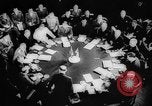
Events surrounding the surrender of Japan during World War II. Scene from the Potsdam Conference meeting. Group of dignitaries together including Clement Attlee, Harry Truman, and Joseph Stalin. U.S. President Harry S. Truman and the General Secretary of the Communist Party of the Soviet Union, Joseph Stalin, in discussion. A parade in Moscow showing Soviet military might (these scenes are from the May 1, 1945 May Day parade just before Germany's surrender). Scene changes to Japanese Emperor Hirohito riding on a white horse in a procession. Next scene shows dignitaries arriving for meeting at the White House in Washington D.C. U.S. Secretary of War Henry Stimson, Secretary of State James Byrnes and Secretary of Navy James Forrestal meet at the White House. Close up view of Secretary Forrestal. View of President Truman with his cabinet in a meeting. Scenes from prior months showing dignitaries involved in the war: Close up of the late President Franklin Roosevelt. A scene of President Roosevelt shaking hands with several Soviet military officers. General Douglas MacArthur seated and talking to President Roosevelt. Close up view of Chairman of Nationalist Government of China, Chiang Kai Shek. View of U.S. Navy Admiral Chester Nimitz shaking hands with a sailor. Views of President Truman meeting in emergency session with his cabinet, and his announcement of the Japanese surrender. View of former Secretary Hull at that meeting. President Truman standing as he reads from a bulletin confirming the Japanese acceptance of the terms of the Potsdam Agreement and their agreement to unconditional surrender. View of media, press, and newsmen running from the White House to file the happy news story. New Yorkers rejoice at the end of war. Daytime scenes of happy, jubilant celebrations on Victory over Japan day, or V-J Day, in the Times Square area of New York City. Crowds cheering, people dancing, soldiers, sailors, and citizens waving hands and American flags. A neon sign with message "Japs Surrender". View of night time celebrations at Times Square as the crowd continues to celebrate VJ Day.

General Joseph Stilwell and General Simon Buckner confer in Okinawa; battle scenes on Okinawa.
General Roy Geiger and General Simon B. Buckner Jr on Okinawa during World War 2 (prior to General Buckner's death at Okinawa in June, 1945. General Buckner and General Joseph Stilwell confer outside a tent. Tanks and infantrymen move at Hill 92 for a battle against Japanese troops. View from elevated position of battle underway and tanks with mounted flamethrowers attacking Japanese machine gun nest positions. U.S. Army soldiers standing on a ridge and firing rifles at enemy positions. Long extension hose is run from tank flamethrower up a hill to reach another enemy position. A Japanese officer with a badly burned face and injuries to neck, head, and arms surrenders to U.S. Army soldiers. He is assisted by U.S. soldiers in climbing over rocks during surrender. Officers feed Japanese officer, a 1st Lieutenant in a Japanese Navy unit, and give him a cigarette which he smokes. They carry him on a stretcher to receive medical attention and further interrogation. (World War II period).