


 Francais
 Deutsch
 Italiano

Refine Your Search
+"United States" +1945 stock footage and images
- Showing 187 to 192 of 4253 results more
 Hide
Scenes of World War II as the Allies converge through Germany towards Berlin.
Animated map shows direction of Allied forces converging on Germany, Western Powers from the West, and Soviets from the East during final phase of World War 2, in Europe. Newspaper headline reads: "Russians strike for Berlin."The New York World-Telegram newspaper headline reads: "Yanks Cross the Rhine!."U.S. Army troops seen in house-to-house fighting in Germany.American troops standing at Rhine River viewing Cologne, Germany. The cathedral at Cologne. Film of Hitler's troops crossing the Rhine in 1936 contrasted with views of many German prisoners of war being marched under Allied guard, in 1945. USAAF P-38 lightning aircraft taking off on mission against German targets. View from Allied aircraft strafing German target which explodes. A P-38 landing on a snowy airfield. USAAF P-47 of the 388th Fighter Squadron (C4), 365th Fighter Group, landing and skidding sideways off the runway. It slides in the snow and strikes another P-47 aircraft with engine running, on the ramp. B-24 Liberator bombers taxing for takeoff. Formation of USAAF B-17 bombers dropping bombs all over Germany. Formation of B-17s at very high altitude, leaving contrails behind them. U.S. infantry and armor fighting in snow-covered streets of German city. Allied troops, including Polish soldiers, fighting in the snow. Allied wounded being carried while under fire from German forces. U.S. Sergeant Peter Di Guiseppi and Private Pat Brady being interviewed. De Guiseppi remarks that the war seems like it will never end. Brady recounts being in a tank that hit a mine or something that exploded and abandoning the tank faster than he could ever imagine. He hunkered down in a ditch while bullets flew all around him, including the ammunition from the destroyed tank.
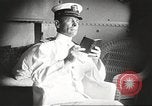
Scenes of Naval Operating Base, Hampton Roads, Virginia in 1925
Naval Operating Base, Hampton Roads, Virginia (renamed U.S. Naval Station Norfolk, in 1945 ). U.S. Navy Commander seated in a chair aboard a ship. A large group of civilian businessmen and officials pose on board a ship with several American Navy officers and one British Naval officer, for a photograph. Some of them stand and some are seated. One civilian stands in front of the group and poses with an American Navy Captain. Change of scene shows Admiral Way on the Navy Base, containing mansions and other structures from the 1907 Jamestown Exposition. It is a very windy day and several civilians are seen on a sidewalk and entering a large building on Admiral Way. Numerous Navy personnel in uniform are seen in the area, including a number of Naval officers entering that building and others heading there along a sidewalk. Residential mansions are seen in the vicinity along Admiral Way.
French POWs and repatriated civilians arriving at Le Bourget Airport in Paris, France, near end of World War II in Europe
Repatriation of French war prisoners and civilians in Paris, France toward the end of World War Two. Three U.S. C-47aircraft in flight approaching the Le Bourget airport. A fleet of U.S.Army Air Forces C-47 aircraft parked on the ramp and some taxiing. Ambulances and vehicles are positioned on the ramp as repatriated French soldiers deplane. Soldiers with their belongings moving in loose formation along the ramp. A C-47 taxiing. Its tail number is 42-24174, belonging to the 34th Troop Carrier Squadron, 315th Troop Carrier Group, of the U.S. 9th Air Force. An Air France JU-52 passenger aircraft is parked on the ramp, and civilians deplane, including Marcel Bloch, a French aircraft builder,who had been imprisoned in the Buchenwald Concentration Camp, until April 11, 1945. (He later changes his name to Dassault, which will also become the name of his aircraft company, after the war). Also among the passengers is Marcel Rene, director of the French paper 'Resistance.' Several views of the aircraft's pilot and the civilian passengers.
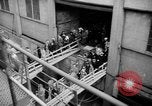
A large number of visitors board the USS Wasp at the Puget Sound Navy Yard, Bremerton, Washington
Visitors board and crowd the deck of the USS Wasp (CV-18) in June, 1945, near the end of world War II. The Wasp is about to depart again, for the Western Pacific, following repairs at Puget Sound Navy Yard, Bremerton, Washington. Two U.S. marines are escorting two women, and showing them an F4U Corsair airplane on the deck. Some of the visitors look up toward the camera. The aircraft on deck have been arranged for this static display. visitors are seen departing across a gangplank. Views from deck of the Wasp, of Navy personnel on the pier, below. Camera pans across the pier where spectators still stand. A few people stand on the water side of a building. A large group of visitors coming up from the hangar deck. Civilians and sailors wave at the camera. Visitors leaving the carrier on the gangplank.
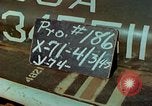
Crash landed USAAF P-47D Thunderbolt at Eschborn Airfield, Germany, near the end of World War II in Europe
Germany about a month before the end of World War 2 in Europe. A crash landed United States Army Air Force Republic P-47D Thunderbolt aircraft, nicknamed "Mom's Irish Mick." It was assigned to the 404th Fighter Squadron, 371st fighter Group, and crash landed on Advanced Landing Ground Y-74 Frankfurt/Eschborn that had been seized by advancing U.S. forces, in 1945. The aircraft carries tail number 44-33253 and was piloted by Charles T. Martin III. Officers retrieve ammunition from the wing gun. Crane brought in to lift the fighter plane also known as the Jug. Crane pulls the P-47 off field. The hulk of a Gotha 242 transport glider stands next to the American flag at half mast with air field tents in the background. A formation of P-47s flies over the flag. Four P-47s buzz and pull up with the flag in foreground. P-47s flying in 'V' formation with American flag in foreground and officers on the ground. Four P-47s circle for landing. A North American T-6 Texan training plane, a.k.a. Harvard, with occupants in both cockpits, taking off and pulling up.
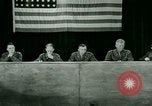
German civilian Pusch testifies in trial of Franz Strasser for shooting of American aviator prisoners; scenes from tribunal in Dachau (WW2)
Excerpts from 24 August, 1945 (World War II) military commission tribunal in Dachau. Swearing in of translator and charges read against Franz Strasser for: "Violation of the Laws and Usages of War. In that on or about 9 December 1944, FRANZ STRASSER, Kreisleiter of Kreis Kaplitz, an Austrian National, did at or near Kaplitz, Czechoslovakia, wrongfully and unlawfully kill an American airman, whose name, rank and serial number are unknown, [by shooting him with a machine pistol]. Strasser replies with a plea of not guilty. Next scene shows entry of German civilian truck driver, Josef Pusch, who is sworn in and provides testimony about the incident. Pusch describes the events of the shooting of the American prisoners by Strasser. United States flag and judges on raised platform. U.S. officials, defendants and civilians in the court room. Shows hearing as it begins. The Nazi commandant seated with other officials. The German civilian is questioned by an interpreter. German civilian Pusch identifies Strasser. Pusch gives his account to the tribunal about the shooting of the American flyers.