


 Francais
 Deutsch
 Italiano
Refine Your Search
+"United States USA" +1944 stock footage and images
- Showing 7 to 12 of 489 results more
more Hide
Hide
Destruction in coastal northeast USA from the 1944 "Great Atlantic Hurricane" (First example of a named hurricane in the US)
Views of The Great Atlantic Hurricane lashing at northeast United States areas (after having already hit the North Carolina Outer Banks), and views of the aftermath and early cleanup following the storm. Regions shown include Atlantic City, Long Island (where it came ashore as a category 3 hurricane on September 15, 1944), New York City suburbs, and parts of New England. High surf flooding boardwalks and coastal cities. Trees bent over and snapped in high winds. People walking with difficulty in the high winds. Streets of towns submerged in water. Coastal docks destroyed and large boats scattered high onto shore areas. Trees, poles, and wires downed over roads and homes. Entire homes moved off of their foundations and placed down the street. The "Great Atlantic Hurricane" was the first example of a named hurricane by the Miami Hurricane Warning Office, which later became the National Hurricane Center. The name was meant to reflect the hurricane's size and intensity.
Americans voting in U.S. cities during 1944 Presidential election; Roosevelt defeats Dewey.
Presidential elections in the United States. Americans voting in various cities. People lined up outside building to vote. Buildings along the sides of the street. Acts and figures pasted on a board. People reading the news. President Roosevelt casting his vote at the Town Hall in Hyde Park, New York. Tabulation of the figure. Crowd at Times Square follow the returns. A board reads: 'National Broadcasting Company Election chart'. Announcements of figures on radio. A woman writing the figure on a board. Announcement of results at the Republican National Headquarters. Governor Dewey conceded defeat and President Roosevelt receives congratulations at Hyde Park.
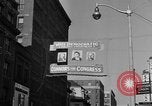
Excerpt from film about national elections in the United States. This segment covers election of November 7, 1944, in World War II
Excerpt from film about national elections in the United States. Opening scene show a banner stretched across a downtown street, reading: "Vote Democratic, vote for full employment. Below that are pictured two local candidates and Franklin D. Roosevelt (running for an unprecedented 4th term as President). Underneath, the banner reads:"Conners for Congress.Glimpses of other political signs are shown, on telephone poles, buildings,and automobile windows. Citizens discuss the elections in various places: A man and woman in their living room; workers in a machine shop; men in a diner restaurant; a man and woman at home; a farmer and a delivery man; a housewife speaks to another homemaker over a back fence; a dentist and his patient; school boys; and politicians. Representative Clare Booth Luce speaking. New York Governor, Thomas E. Dewey, at a podium. Vice Presidential candidate Harry Truman about to speak. People gathered in local forums and other political campaign activities. President Roosevelt driving along a city street, on a rainy day, in an open car with Secret Service agents riding on the running boards of his car. Crowds jamming the sidewalks in spite of the weather. Other gatherings of people waving American flags and showing support for their politcal parties and candidates. Philip Murray, President of the CIO Labor Union and AFL Head, William Green. Radio broadcast antenna shown denoting importance of radio for political communications. Harry S. Truman (Democrat), Thomas E. Dewey (Republican) and incumbent President Roosevelt are seen delivering speeches in front of numerous microphones. Various views of many men, women, children, and families gathered around radios listening to radio campaign speeches, in various places, including American soldiers at the front (This election is during World War 2) and Nurses in a hospital. President Roosevelt speaking at a political dinner. Views of people at political party conventions. Next, people are seen calmly walking in and out of polling places. Three members of an election board begin counting votes. After checking, one member telephones the results from their precinct to headquarters. Views of recorded votes being reported by telephone. People using tabulating machines to compile the results. Views of spectators in vote posting centers awaiting the results. Final results being brought to news media for dissemination to the nation. People gathered in Times square, New York, where news is posted in moving lights on the Times building marquee. Others gathered around their radios. Marquee Lights on the Times Building announce the reelection of President Roosevelt.
Launches of several U.S. Warships during World War II
Preparations for launch of the USS Hancock (CV-19) at Fore River Shipyard, Quincy, Massachusetts, on January 24, 1944. . Shipyard riggers removing supports from under the ship's hull. Platform at bow is decorated with bunting. Scene shifts to Brooklyn Navy Yard, New York, and the launching of the USS Missouri (BB-63), on January 29, 1944. Crowd gathered around the bow as the Missouri goes down the ways. Another change of scene to the Newport News Shipbuilding and Dry Dock Company of Newport News, Virginia. Here the ways are emptied following the launch of the Light Cruiser, USS Hancock (CL-81) on June 19, 1943. The Hancock can be seen in the water. Tugs attend to the newly launched Cruiser.
Film about production of war materiel in the United States during World War II
A war production worker in a tire manufacturing plant during World War 2 is seen handling a very large rubber tire. Tires are stacked as high as the ceiling in a warehouse. Closeup of countless artillery shells standing side by side with their noses pointing upward. Small arms cartridges spilling from a hopper. Rolls of ammunition being packed into steel boxes by women in a factory. Two army officers watch an M3 Army half track leaving a factory. Lower sections of M7 Priest Howitzer Motor Carriages built on M3 Lee medium tank chassis, are seen leaving the American Locomotive Company factory on a railroad. Their turrets have not yet been installed. One of them is marked as the 50 thousandth manufactured at that facility. M2 medium tanks leaving a factory. M24 Chaffee tanks driving out of a factory in 1944. M10 tank destroyers (3-inch Gun Motor Carriages M10) driving in a parking field. A field full of many M4 Sherman tanks. New jeeps driving out of a factory. A yard filled with parked jeeps. New B-17 bombers being towed out of a Boeing factory. One of them has serial number 44-6519. (Assigned to the 602nd Bomb Squadron, 602nd Bomb Group at Northampstead, Hertfordshire England, It was downed by antiaircraft flak fire over Nienberge, NW of Munster,Germany on 28 October, 1944.) Engines moving on an overhead crane in a factory. Wooden power boats under construction. A huge stack of pipes in an outdoor storage yard. Heavy containers being placed on wooden shipping pallets by fork lifts. Anti-aircraft guns being transported on a railroad train pushed by a steam locomotive. Numerous 105mm covered howitzers lined up with barrels crossing one another. Rows of parked Sherman tanks. Column of parked army field ambulances. A yard filled with parked army vehicles. Crane at work in an industrial plant yard filled with pipes and building materials. Petroleum workers rotating valves on oil pipelines. Men placing fueling pipes into open railroad tank cars. A rail yard fulled with tank cars. Another rail yard with numerous tracks full of freight cars and steam locomotives. A crane moving 55 gallon drums in a petroleum storage yard.

General Eisenhower as a World War II officer and as the U.S. President.
Scenes from life and career of Dwight D Eisenhower, 34th President of United States. U.S. Air Force plane lands and the President disembarks the plane in India, in 1959. He is greeted by the Indian President Dr Rajendra Prasad and other dignitaries. Emblem of 'Panama'. Sign of 'welcome Ike Crusader'. Large crowd welcomes Eisenhower. Motorcade goes through the city's street. Milestones in General Eisenhower's life and the international esteem with which he is held. Lt Col Eisenhower concerned about U.S. isolationism in 1940 as World War 2 is underway. Explosions in Europe due to bombing by German aircraft. Eisenhower and other officers in the General Staff study a map. Eisenhower plans the strategy as the commander of Operation Torch (he is shown talking to General George C. Marshall and Winston Churchill). President Eisenhower visits 4 continents and meets several leaders. Large crowds welcome him. General Eisenhower prepares for D-Day Invasion of France during World War 2. June 5, 1944: The Allied forces including troops, artillery, equipment, ammunition, aircraft and ships prepared. June 6, 1944: The Allies invade Normandy. Troops wade through the water during D-Day Normandy beach landings, while under enemy fire. German soldiers surrender. May 7, 1945: Nazi General Alfred Jodl signs the unconditional surrender of his government. General Eisenhower returns to the U.S. He receives a hero's welcome in New York during a parade. He visits his hometown in Kansas. Pictures of his family, childhood and college days. Eisenhower on his visits to various countries as President.