


 Francais
 Deutsch
 Italiano
Refine Your Search
Australia 1942 stock footage and images
- Showing 103 to 108 of 2479 results more
more Hide
Hide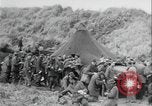
U.S. Military unload supplies to support an aerial bombing campaign of the Japanese in the Aleutian Islands, Alaska, 1942, during World War 2
U.S. troops gathered around a tent, eating, in the Aleutian Islands, Alaska, in 1942, during WW2. A line of soldiers carrying plates and bowls and cups waits to receive food. A man cooks food on a stove. Soldiers sit on the ground eating and warming by a fire. Wide view of the beach with ships and cranes out on the water. Crates of supplies stacked on the beach, soldiers move about. A soldier stacks an ammunition crate onto a large pile. Dozens of unfinned cylindrical bomb bodies on the shore. A crane, tractor, and bulldozer are unloaded from a boat. Panoramic view of a wide flat area to be built into an airfield, covered in shallow lakes.
U.S. Army Air Force bombers raid Japanese-held Kiska Island in the Aleutian Islands, Alaska, 1942, during World War 2
U.S. Army Air Force (USAAF) soldiers wearing flight suits board bomber aircraft from a newly established U.S. position in the Aleutian Islands, 1942, during WW2. A soldier pokes his head out a window in the cockpit of one of the aircraft. Bomber aircraft take off from a runway constructed from marston mat (pierced steel planking), mountains in the background. Scenes of the bomber aircraft in the sky, taken from an on-board camera. Close up shots of gunners at their positions. The bombers fly over the foggy islands toward the Japanese base on Kiska Island. A Japanese warship appears in the water far below, one of the U.S. gunners strafes the deck of the ship. Close up of machine gun firing at the boat. Now over Kiska, bomb bays open and American bombs are unloaded. Smoke and explosions far below. A second load of bombs drops toward the Japanese base in slow motion. Wide shot of the target, now covered in streaks of smoke. Shot of the American bomber aircraft in the sky, turning to head back to base.
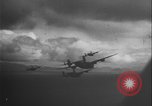
U.S. Army Air Force B-24 bombers return from a raid on Japanese-held Kiska Island in the Aleutian Islands, 1942, during World War 2
U.S. Army Air Force B-24 bombers fly back to base after bombing the Japanese base at Kiska Island, Aleutian Islands, Alaska, in 1942, during WW2. Narrator details the events of the successful mission. Close ups of the B-24 Liberators as they fly over water. Vast mountains of the Aleutian Islands in the background. The aircraft land back at the newly established U.S. base in the Andreanofs of the Aleutian Islands. Close ups of the bombers, now on the ground. U.S. soldiers exit the aircraft, inspect damage taken from Japanese fire on the fuselage. A group of U.S. pilots and crew walk across the airfield. Soldiers circle around and chat. Ending scene of soldier standing with cloudy Aleutian mountain rising in the background.
Montage of scenes related to 1942 Fall of Corregidor, the Bataan Death March, POWs and destruction of manila, in World War II
World War 2 scenes related to the Philippines. Opening shot shows Japanese troops unceremoniously taking down American flag in 1942, followed by superimposed images of Japanese soldiers boots trampling over U.S. flags. Next, U.S. Lieutenant General Jonathan Wainwright with members of his staff, are seen seated at a table in the Japanese headquarters building on Bataan to discuss surrender with General Masaharu Homma, Commander of the 14th Japanese Imperial Army. Homma has General Wachi at his left and Colonel Nakayama to his right. Repetition of the superimposed Japanese army boots trampling American flags. Next, U.S. defenders of Corregidor are seen surrendering to Japanese troops in 1942, and then being marched under guard to Mariveles, where the infamous Death March commenced. Several views of the American and Filipino prisoners marching under guard. Glimpse of American combat helmets piled up in a heap. Views of the POWs without helmets, using white cloths over their heads to protect from the sun. Huge numbers of POWs held in an open area for the night, and then marching again during the day. One who had fainted is carried in a blanket by several others. Illustrations of POWs being tortured by Japanese soldiers. Views of two POWs, who died during the march, lying on the ground. Next scene shows emaciated Allied POWs in 1945 being freed by American soldiers from a Japanese prison camp. American soldiers speaking with another group is a section of prison behind a sign reading: "Dysentary, Keep Out." Undernourished former prisoners of war eating a meal. One smoking a cigarette. Aerial view showing large swaths of Manila, Philippines, destroyed by Japanese forces retreating from advancing American forces. Smoke rising along a line of destruction in the background. Bodies of numerous Filipinos lying amid rubble in the streets of Manila. Many have hands tied behind their backs. Glimpse of dead children. Cadres of Japanese soldiers raising victory cheers. New Japanese conscripts in large formations during military training for new recruits following draft. Japanese naval trainees in white uniforms, waving their hats. Huge crowd of Japanese people cheering, followed by view of Emperor Hirohito, in Army uniform, saluting as he stands on a balcony. Cheering Japanese people, at a rally in a stadium.
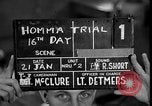
Major Tisdell recalls events of April 8, 1942 in Bataan, Philippines during the Homma trial in Manila, Philippines.
U.S. Army Major Achille C. Tisdell testifies before a military tribunal in Manila, Philippines during the trail of Japanese Army General Masaharu Homma for World War II crimes. Major Tisdell takes an oath on the 16th day of the Homma trial. He says that he was aide-de-camp to Major General E.P. King, Commanding General of the American forces in Luzon in April, 1942. Major Tisdell recalls that Japanese forces had pushed back the American forces in Bataan to a point that it was difficult for the Americans to reorganize. He also talks about the lack of ration for the American forces. Major Tisdell says that U.S. reserves were released for the forces. He says that on 9th April, 1942 General King was unable to make contact with Japanese commander and Colonel Edward C. Williams volunteered to make contact with the Japanese.
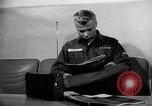
The story of AFN ( American Forces Network) Radio. Founding announced in 1942. First broadcast in 1943; growth in 1944.
U.S. Army soldier reads newspaper while listening to radio. Soldiers doing their respective chores, listen to AFN (American Forces Network) Radio. General Marshall and General Eisenhower announce the creation of AFN, in 1942. July 4, 1943, the first broadcast of AFN. General Eisenhower mingling with paratroopers of the 101st Airborne Division, on the eve of D-day. U.S. B-26 aircraft in flight. United States soldiers aboard landing craft and wading ashore at Normandy, France, on D-day, June 6, 1944. Soldiers tuning radios in the field. United States Sherman tanks and infantry move along country road in France. Audio includes portions from AFN broadcasts, including an announcer saying "You are listening to AFN Paris. This is the American Forces Network, on the road to Berlin." Road sign points to St. Lo. Group of U.S. soldiers gathered around a jeep with a radio, listening to AFN, in Germany. (World War II period).