


 Francais
 Deutsch
 Italiano
Refine Your Search
B-24-Burma stock footage and images
- Showing 745 to 750 of 3692 results more
more Hide
HideColor Sound
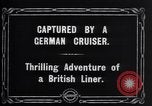
British steamship 'Galician' is stopped at sea by German cruiser off the Canary Islands, in World War I
Slate reads: "The Union Castle Steamship, 'Galician' from Capetown to Southhampton, was on August 15th, when off Teneriffe, signalled to stop by the German Cruiser, 'Kaiser Wilhelm Der Grosse.' Next slate reads: "The 'Kaiser Wilhelm der Grosse,' had been transformed from a liner, whilst at sea, six heavy guns and 24 machine guns being mounted." A brief view from the "Galician" of the German four-stacker auxiliary cruiser, "Kaiser Wilhelm Der Grosse." The next slate reads: "Bearing down on the 'Galician' at a speed of 24 knots, the cruiser signalled to the liner to 'Heave To.' The marconi operator sent out the 'S.O.S.' distress signal and the cruiser ordered 'Cease communication or we will sink you." Two officers photographed on deck of the "Galician." View of the Cruiser near the "Galician." Boat carrying German boarding party arrives at the ship and they climb the ladder to board. A German sailor seen aloft at the "Galician's" mast, disabling her marconi wireless antenna. A torn white ensign (missing a canton) flies from the mast. Captain and officers of the "Galician" pose for photographer (marconi operator). Slate lists British military personnel aboard, who were taken as prisoners of war. One of them is photographed. The German boarding party leaves the ship taking their prisoners with them. The German Cruiser seen departing. Civilian passengers and crew aboard the "Galician," pose celebrating their relative good fortune.
Members of U.S. tank-infantry team make a reconnaissance in force across 38th Parallel, during Korean War
American tank crews prepare for an armed reconnaissance mission, across the 38th Parallel, into area formerly held by Chinese forces, during the Korean War. They are seen loading machine guns and preparing their M24 Chaffee tanks. The tank convoy underway. Jeeps seen parked in background. An M24 tank fording a stream. Infantry moving ahead of the tanks, check for land mines. The team is delayed at a culvert, where retreating Communist forces had destroyed a bridge. Army engineers take measurements to determine equipment needed to span the gully. One of the tanks by-passes the spot and follows an alternate path near some village dwellings. A following jeep bogs down, so a tank returns to smooth the area, allowing the jeep to pass. Tank passing a local house. Another tank caught in soft earth at edge of dirt road. Another tank attempts to pull it out without success. U.S. soldiers gather and discuss the situation. Several soldiers pick up Chinese propaganda leaflets. Tanks continuing on their mission.
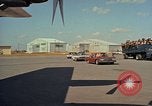
United States President John F. Kennedy inspects flight line at the Homestead Air Force Base in Florida, during the Cuban Missile Crisis
A small motorcade of three cars led by a red open convertible carrying President John F. Kennedy, Air Force General Walter Campbell Sweeney Jr. in the back and Secret Service agents and another Air Force officers in the front. An Air Force open stake truck carries members of the press and photographers, driving alongside the President's car. An Air Force Lieutenant Colonel in a flight suit, standing by a microphone, salutes as the President's car pauses and listens to him speak. The President's car is next seen parked near a C-130 transport aircraft, and surrounded by Air Force photographers taking pictures. A formation of F-105 aircraft flies low overhead. Close view of the President and occupants of the red car watching the formation. An Air Force Lieutenant Colonel wearing a flight suit speaks to the President who points toward the flight line, where numerous aircraft are parked on static display. The first seen are F-105s. View from moving car as it proceeds along the flight line. Next an F-100 aircraft is seen. then an F-84F; an F-104; Several Navy tactical aircraft including an F-4 Phantom fighter. A Douglas A-1 Skyraider is the last fighter type seen. Parked behind it is a C-124C cargo aircraft, and next to it is a C-133 cargo plane with six crew members who salute as the President's car passes. The President's car stops near a C-130 aircraft. View from behind General Sweeney and the President. Next, Lieutenant Colonel Robert M. Strickland is seen speaking. He is in fatigues and wears the Tactical Air Command patch on it. Closeup of the President listening to him. Formation of 24 F-105s and 24 F-84Fs flies overhead. Closeup of the President watching them. Film ends showing the formations overhead.
Science fiction filming and actual rocket-related activities and events in Germany
A 1940 movie entitled "Weltraum Schiff I Startet Eine Technische Fantasie" (Space Ship I launches a technical fantasy). Imaginary view of moon shining over Lake Constance in Friedrichshafen in the future. Views of a huge hangar and industrial complex with a rocket on a launch pad. A large crowd is gathered and listens to a technician speak about a moon rocket.project. Supposedly, the director of the Friedrichshafen airship shipyard speaks to some reporters about aircraft, flying, rocketry, and space travel, while speaking about manned rocket flight to the moon. He answers questions from members of the press corps. Animated pictures show critical distance for escaping earth's gravity and other aspects of a moon flight. Posters of various German Dornier airplanes line the briefing room, including: a circa 1937 Dornier Do 17; Dornier Do 24 3-engined flying boat; Do-X 6-engined flying boat; Dornier Do J II Wal; Dornier Do-19 aircraft; Dornier Do-18 push-pull twin engine flying boat, and the mammoth Do-X twelve-engine flying boat with its date, 1929, stenciled on the bottom of its left wing. From this point on, the narrator continues speaking but the images are of actual applications of rocketry to land vehicles and aircraft. View of a small rocket fired from a tilted trough type launcher. A sign warns about fire explosives ("Vorsicht Mit Feuer SprengstoffI"). Igniter being wired to rockets on the Opel RAK-2 rocket propelled car. Max Valier sitting in his rocket propelled car Valier RAK-6. Fritz Von Opel sitting in his rocket propelled car, Opel RAK-2. Fritz Von Opel driving his rocket propelled car, Opel RAK-2 at Avus track in Berlin on May 23, 1928. A sign above the seating area reads: "Zeitnahme" (Timekeeping). Driven by 24 solid-fuel rockets, the car raises smoke and dust in its wake as it reaches a speed of 230 km/h (143 mph). Brief view of the Opel-Sander Opel RAK-.3 Zopeltra rocket rail rider racing along a track in 1928. The Opel-Sander RAK-1 rocket propelled airplane on a launching rail. With Opel at the controls, It fires up and takes off in a cloud of smoke, at Frankfurt-am-Main airport, on 30 September 1929. A rocket test resulting in failure, as the rocket tumbles to the ground after rising only a short distance after launch. Men gather around a liquid oxygen tank as it fuels a rocket car driven by Max Valier. His white car is seen speeding along the ramp of an airport, past a twin engine high-wing monoplane. Next, Valier is seen in April 1930, smiling as he sits in his liquid rocket propelled car, surrounded by spectators. Glimpse of a rocket vehicle on a railway, as it fires up sending a cloud of smoke that obscures the scene completely. A poster showing starry sky and reading:"Die Erreichbarkeit Der Himmelskorper" (The accessibility of the celestial body). Fingers working rapidly on an arithmetic calculator. Fumes rising from a beaker of liquid oxygen. A technician (hands only, seen) pours liquid into one of a number of beakers in a laboratory. It produces a chemical reaction causing dark smoke to rise from the beaker. (World War II period).
First group of U.S. soldiers leaving for discharge in U.S. Army Air Force C-54 Skymaster transport in Okinawa during World War II.
First group of soldiers to leave Okinawa for discharge assemble at U.S. 24th Corps Air Regulation Office on Yontan airstrip during World War II. Soldiers leave truck. A sign reads '24th Corps Air Regulating Officer'. U.S. Major General Archibald V Arnold talks to the departing soldiers and signs short snorter bill for one man. Soldiers board U.S. Army Air Force C-54 Skymaster transport aircraft. The C-54 taxis and takes off.
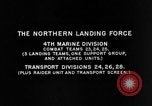
Information about the composition of northern task force for operations on Kwajalein Atoll in the Marshall Islands is given.
A training film on operations of U.S. forces on Kwajalein Atoll in the Marshall Islands during World War II. Northern task force is composed of several groups. These include the northern landing force which comprises of the 4th Marine Division. This in turn is made up of combat teams 23, 24 and 25. Each landing team is composed of three landing teams, one support group and attached units. The remaining group consists of Transport Divisions 24, 26 and 28. They also include a raider unit and a transport screen. The northern support group, the northern carrier group, the initial tractor group, the reserve tractor group and the mine sweeper and the salvage group are also included. Information about the shipping of the northern attack force is given. Aerial view of ships underway at sea. Interior of a ship. Joint operations room, combat information center room, intelligence office, communication room, photographic and reproductions rooms on the ship. Signal and communication equipment. The ship convoy underway, advancing towards the target area. Men aboard ships. An aircraft in flight overhead. An officer studies a map and instructs personnel.
CRITICALPAST.COM: About Us | Contact Us | FAQs - How to Order | License Agreement | My Account | My Lightboxes | Shopping Cart | Advanced Search | Featured Collections | Website Terms & Conditions | Privacy Policy ©2026 CriticalPast LLC.
License Agreement |
Terms & Conditions |
Privacy Policy
©2026 CriticalPast LLC.