


 Francais
 Deutsch
 Italiano
Refine Your Search
B-24-Burma stock footage and images
- Showing 751 to 756 of 3692 results more
more Hide
HideColor Sound
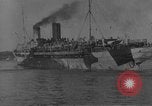
Belgian soldiers who had been fighting against German and Austrian forces, in Russia, in World War I, arrive by ship in Bordeaux, France.
The French line ship, SS Lorraine, in camouflage paint, seen backing into port at Bordeaux, France, on June 24, 1918. Belgian troops of the ACM Corps (Autos-Canons-Mitrailleuses, Belgian armored unit) disembark. They are seen as they walk down a gangway from the ship, in combat uniforms and steel helmets, and carrying their weapons and personal gear. (Note: Soldiers of this armored unit from Belgium fought alongside the Imperial Russian army against German and Austrian troops in 1915 in Russia, during World War 1, before the 1917 Bolshevik revolution, after which they were stranded in hostile territory. They left Vladivostok for the United States on the SS Sheridan, and docked at San Francisco on May 12, 1918. They were warmly greeted as they proceeded across the U.S. to New York city, where they participated in the Memorial Day Parade. After leaving New York City, aboard the SS La Lorraine, they reached Bordeaux on June 24 1918.)
Captain Kellet, Captain Jarnigan and Sgt. Albert Miller during the attack mission over Malabang in Philippines Island.
U.S. Army attack mission over Malabang in Lanao del Sur Province in Philippines Island. The U.S. Army units on a field. U.S. Army Captain Kellet, standing near an army jeep, radioing pilots on bombing targets. Soldiers stand beside the Captain. Sgt. Albert S Miller sitting on an army jeep and passing information to the radio jeep on the walkie-talkie. Captain Jarnigan briefing the pilots on the bombing areas, showing them the locations on a map spread out on the front of the jeep. The pilots gather around and look at the map. A-24 taking off from the field. Another A-24 taking off. A vessel in the ocean. (World War II period).
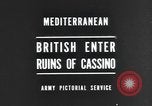
Re-enactment of British forces occupying the town of Monte Cassino, Italy, in World War II
Montage of scenes recorded after the Battle of Monte Cassino in World War 2. Opening scene shows New Zealand 19th RHQ tank in Mignano Montelungo, as the 24th New Zealand Battalion re-enacts its entry into the ruins of Monte Cassino, on March 26, 1944. In this restaging, 24th Battalion infantrymen are shown moving through rubble of destroyed town, firing small arms and one throwing a hand grenade. Narrator identifies "Hangman's Hill," (which was held by the 1st battalion 9th Gurkha Rifles) at Monte Cassino. In this restaging , New Zealanders, scramble over rubble, and dig out a "wounded" comrade, while explosions occur in background. Medics "attend" to him. Other NZ troops fire small arms from behind rubble barriers. A huge explosion occurs in background. A British artillery piece (obscured by debris) fires rounds. Infantrymen fire small arms. A camouflaged British tank fires its gun. In change of scene, other British troops advance cautiously near a damaged building and take several German soldiers prisoner. View of the destroyed Monte Cassino monastery and castle on Castle Heights. Ruins of building adjacent to the "Hotel Excelsior,"below the castle. Several medics with Red Cross flag in distant rubble. Views from destroyed Monastery atop the mountain. (World War II; WW II; World War 2; World War Two)
A demonstration about creating a gap in a 30 degree sloping wall with the help of bar charges in the United States.
A demonstration shows bar charges being placed and exploded against a wall in the United States. The face of a 30 degree sloping masonry wall. 24 packs of bar charges are placed on the face of the wall. An explosion occurs and smoke rises. The explosion results in an 18 feet wide gap. A U.S. Army tank passes through the gap. 24 packs of bar charges are placed at the center of the masonry wall. An explosion occurs and billows of smoke rise. A 16 feet wide gap is created and a U.S. Army tank passes through the gap.
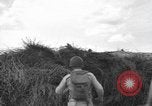
A demonstration about creating gaps in various walls and obstacles with the help of bar charges in the United States.
A demonstration shows bar charges being placed and exploded against a wall in the United States. Soldiers place bar charges on a Japanese stump wall. 24 packs of bar charges are placed on the wall for detonation. An explosion takes place and smoke rises. The explosion results in a 12 feet wide gap in the wall and tanks pass through the gap. The bar charges are placed on a five feet high Japanese log wall. An explosion occurs and a 15 feet and 3 inches wide gap is created. A U.S. Army tank passes through the gap. 24 packs of bar charges are placed on a Japanese wall and an explosion occurs. Smoke rises due to the explosion. A U.S. Army tank passes through the 16 feet wide gap created in the wall. The soldiers near the bar charges. They place the charges under water for a detonation. A steel obstacle. The bar charges are placed at the joint of a member of a steel fence for a detonation. (World War II period).
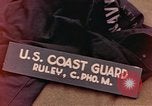
Allied fleet underway towards Normandy, France as a signal man mans a signal light during World War II.
Allied fleet underway in the Atlantic Ocean towards Normandy, France during World War II. Two United States Coast Guard men aboard an LCI ( Landing Craft Infantry). A British battleship of the Warspite class underway at sea. A British transport ship underway. A British Coast Guard, with a Red Cross on his steel helmet, smokes a cigarette aboard a vessel. A destroyer of Livermore class underway at sea. An LST ( Landing Ship Tank) with a barge pushed up to the loading ramp. A Landing Craft Infantry loaded with soldiers at sea. A signal man mans a 24 inch signal light on the signal bridge of a vessel. He unlocks the pivot of the 24 inch signal light.
CRITICALPAST.COM: About Us | Contact Us | FAQs - How to Order | License Agreement | My Account | My Lightboxes | Shopping Cart | Advanced Search | Featured Collections | Website Terms & Conditions | Privacy Policy ©2026 CriticalPast LLC.
License Agreement |
Terms & Conditions |
Privacy Policy
©2026 CriticalPast LLC.