


 Francais
 Deutsch
 Italiano
Refine Your Search
B-24-Burma stock footage and images
- Showing 763 to 768 of 3692 results more
more Hide
HideColor Sound
Plywood used to make crafts, boats and airplanes for the Invasion of Normandy during World War 2
Plywood used to make war material for the Invasion of Normandy. Birch, maple and mahogany logs are boiled for 24 hours. The logs are rounded on rollers and then peeled into long sheets of veneer. Women war production workers take out thin sheets of wood made from the logs. The sheets are then put into drying ovens to reduce the moisture. Women make an alternating wood and glue pile. These are stacked and put into a machine press to make the finished plywood. Workers put together and weld the prepared plywood. The plywood is used to make landing crafts, boats, pontoons, army holding boards, gliders and fighter planes. Men construct boats and crafts. A glider takes off. Worker under the plane. British de Havilland Mosquito bombers parked in a row. The plywood was a major component of the Mosquitoes .
Disabled veterans trained as watchmakers at Joseph Bulova Watch Corporation school in New York.
Disabled veterans of World War 2 are trained as watchmakers at a school in the Woodside suburb of Queens, New York City. Disabled veterans enter the Joseph Bulova School of Watchmaking (40-24 62nd St., Flushing, NY 11377). Doors with electric eye controls open school doors automatically for students in wheel chairs. The school also includes a wheelchair ramp. Disabled veterans in wheelchairs enter the school, followed by others walking. Faculty teach the men in a group. Some of the veterans were formerly employed as truck drivers, a chef and a music teacher. Veterans work on various equipment and manipulate small parts of watches. Veterans in a class receive training to receive new jobs as watch makers.
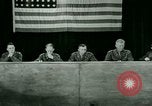
German civilian Pusch testifies in trial of Franz Strasser for shooting of American aviator prisoners; scenes from tribunal in Dachau (WW2)
Excerpts from 24 August, 1945 (World War II) military commission tribunal in Dachau. Swearing in of translator and charges read against Franz Strasser for: "Violation of the Laws and Usages of War. In that on or about 9 December 1944, FRANZ STRASSER, Kreisleiter of Kreis Kaplitz, an Austrian National, did at or near Kaplitz, Czechoslovakia, wrongfully and unlawfully kill an American airman, whose name, rank and serial number are unknown, [by shooting him with a machine pistol]. Strasser replies with a plea of not guilty. Next scene shows entry of German civilian truck driver, Josef Pusch, who is sworn in and provides testimony about the incident. Pusch describes the events of the shooting of the American prisoners by Strasser. United States flag and judges on raised platform. U.S. officials, defendants and civilians in the court room. Shows hearing as it begins. The Nazi commandant seated with other officials. The German civilian is questioned by an interpreter. German civilian Pusch identifies Strasser. Pusch gives his account to the tribunal about the shooting of the American flyers.
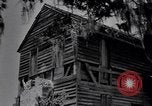
Forks of Cypress plantation home and other sites, likely in Alabama, circa 1939; African American man tending a large bell.
From the U.S. Department of Agriculture documentary "The Land." A seemingly abandoned, dilapidated house at an unidentified farm or former plantation location, possibly in Alabama, during the Great Depression. Spanish moss hanging from nearby trees. Views of a different, wooden, rundown house with a front porch, possibly at a different location. Scene changes again to a third different house, this one made of brick. A lone African American man emerges from double doors of the house. He walks up to a bell, cleans it, and rings it. Distant open view in front of the bell includes a valley and river (possibly the Tennessee River in western Lauderdale County, but not confirmed.) Scene changes again to show the first house and the trees with Spanish Moss. View returns to the location with the man tending the bell. Next scene shows the Forks of Cypress plantation house in Florence Alabama, (Lauderdale County). View of the old main Greek Revival Forks of Cypress house built in 1830 for James Jackson. View of the west elevation of the house. The smokehouse is seen behind and to the side of the main house. A clothes line with clothes on it is beside the smokehouse. Chickens walk on the porch of the house, past its tall colonnade of 24 ionic columns. (Note: The house burned completely in a 1966 fire). Next scene is again the elderly African American man at the brick house location. He looks around, mumbling to himself, walks back towards the house, and pauses on the front steps. The first wooden house with Spanish moss in nearby trees is shown again. Scene returns to the elderly African American man who enters the brick house and closes the doors behind him. Film directed and narrated by Robert Flaherty.
Propaganda piece shows Soviet troops, military equipment, agriculture, and industry contributing to the progress of the USSR.
United States Air Force Soviet Awareness Program shows a Soviet propaganda film with English translated voice over. Soviet troops rest after a training mission. Russian soldiers seated on and around tanks. Mountainous and wooded regions in the Soviet Union. Modern, developing, industrialized areas and cities. Women work in factories. Roads under construction. Modern farm equipment and views of farm fields in the Soviet countryside. The Soviet War Memorial or the Soviet Cenotaph in Berlin's Treptower Park. Soviet soldiers descend steps into a Soviet missile silo. Changing of personnel in a 24 hour missile silo. Soldiers at attention as a military band plays. Soviet soldiers salute. A Soviet soldier stands guard in the snow. A mission control center with men seated at some radar screens. Soviet soldiers on duty in various places. A Soviet pilot or astronaut in an aircraft or spacecraft cockpit.
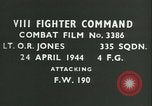
U.S. AAF VIII Fighter Command Lieutenant O.R. Jones attacks a German FW 190 in Germany during World War II.
U.S. Army Air Forces Eighth Air Force, VIII Fighter Command operations in Germany during World War II. 24 April 1944: Lieutenant O.R. Jones of the 4th Fighter Group 335th Squadron attacks a German Luftwaffe Focke-Wulf FW 190 fighter aircraft. The U.S. aircraft in flight amidst clouds. The FW 190 in sight. The two aircraft in a dogfight. Firing and explosions.
CRITICALPAST.COM: About Us | Contact Us | FAQs - How to Order | License Agreement | My Account | My Lightboxes | Shopping Cart | Advanced Search | Featured Collections | Website Terms & Conditions | Privacy Policy ©2026 CriticalPast LLC.
License Agreement |
Terms & Conditions |
Privacy Policy
©2026 CriticalPast LLC.