


 Francais
 Deutsch
 Italiano

Refine Your Search
B-24-Burma stock footage and images
- Showing 2521 to 2526 of 3692 results more
 Hide
Color Sound
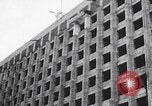
Allied prisoners of war leave Popesti Airfield during Operation Gunn, WWII
15th Air Force Operation Reunion (Operation Gunn) to rescue Allied prisoners of war in Romania during World War II. Evacuation of 1,161 Allied prisoners of war (POWs) from Romanian hospitals and Popesti Airfield, near Bucharest, Romania. Men carry injured Allied POWS out of a hospital. An emaciated Allied POW flexes his muscles while lying on a stretcher. Men place the patient in ambulance. A disabled POW with crutches walks out of the hospital. Two men assist another POW walking with crutches. Injured Allied prisoner of war smiling. A POW smiles while walking with two canes. A man on the stretcher smiles as he is being carried out of the hospital for his evacuation. Allied prisoners of war sit inside the bus. Major Colonel Doctor Ford shake hands and say goodbye to the POW evacuees inside the bus. The bus departs for Popesti Airfield. Prisoners of war evacuees wave their hands from the windows of the bus. Groups of buses carrying POWs drive to Popesti Airfield. Boeing B-17 Flying Fortress bomber takes off from Popesti Airfield. Groups of POWs form a line before boarding the evacuation bombers. A B-17 Flying Fortress bomber taxiing. Fighter escorts circle above Popesti airfield during the evacuation. Allied POWs wave at the camera goodbye as they board the aircraft. Men carry a prisoner of war on a stretcher to the aircraft. Wounded prisoners of war are given priority to board on evacuation flights. An injured young pilot waiting while lying down on a stretcher. Men raise the stretcher up the B-17 Flying Fortress bomber’s bomb bay door. Injured POWs on stretchers are taken inside the evacuation aircraft through the bomb bay door. Medics accompany injured POWs during the evacuation flight.

English Electric Canberra prototype jets take off from an airfield and fly over England
British aviation developments after World War II. A twin-jet English Electric Canberra takes off from Warton Aerodrome, Lancashire, England. The English Electric Canberra A.1 prototype (VN799) in flight. The first Canberra B.2 prototype (VX165) flies over the airfield. Crowds of British civilian men and women watch the first Canberra B.2 prototype in flight. The first Canberra B.2 prototype performs maneuvers.

Liberated Frenchmen welcomed back to Paris.
A USAAF Martin B-26 bomber taxis away from the parking area at an airport in Paris. A long line of B-26s on the perimeter strip with engines turning over. A group of army personnel standing near the hangar. USAAF Douglas C-47s or Skytrains pull up on perimeter strip. French Guard and Band takes position. Officers rush towards the planes to receive the passengers. Liberated Parisians and Frenchmen climb out of a C-47 and walk through Honor Guard. French band playing in the background. A view of the French flag flying. Liberated citizens leaving in trucks as civilians wave to welcome them home. Honor Guard presents arms as an injured Frenchman is carried past them on stretcher. French band playing in the foreground as liberated French soldiers pass. (World War II period).
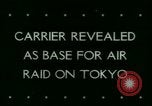
Lt. Col. James Doolittle directs the Doolittle Raid on Japan and receives an award from Madam Chiang Kai-Shek.
From a 1943 newsreel covering the Doolittle Raid on Japan in April 1942. United States Navy aircraft carrier USS Hornet (CV-8) in Japanese waters. B-25 Mitchell medium bomber planes lined up on the deck of the carrier. Lt. Col. James Doolittle and Hornet skipper Captain Marc A Mitscher with the 80 volunteers seated near a 500lb bomb on board. He ties a Japanese medal (awarded to U.S. officers for humanitarian aid to Japanese people) on the bomb. The carrier in heavy seas 800 miles off the Japanese coast. A Japanese patrol boat is sighted and sunk. The survivors are taken prisoners. The crew readies the loaded bombers. General Doolittle in the cockpit as he leads the takes off. The planes take off in rough weather to bomb Japan. The Yokosuka Naval Base bombed and ablaze. The planes bomb armed plants, rail yards and oil refineries all over Japan. Soldiers examine a wrecked B-25 in Japan. U.S. pilots hold traditional Chinese umbrellas and pose with a Chinese man. Chongqing: Soong May-ling, better known as Madame Chiang Kai-shek, awards General Doolittle and his men for the gallant raid. (World War II period).

The testing of a supersonic propeller in research and development center of Wright Air Development Center in the United States
Research and Development at the Wright Air Development Center (WADC) of Wright-Patterson Air Force Base. The test of supersonic propeller. Two technicians take reading from instruments during test. Aerial side view of B-50 Stratofortress aircraft in flight. View of B-50 aircraft engine during flight. A technician records data while in flight. Technician analyzing sound levels of the aircraft.
Various aircraft and aviation tests and testing equipment used at Wright Air Development Center
Aircraft undergo various tests at the Wright Air Development Center of Wright-Patterson Air Force Base. Testing of magnesium burner attached to an aircraft flying at night for night photography. A static lightning test is done on a model of a F-84 Thunderjet aircraft, for the study of interference. A technician seated at an electron microscope instrument panel adjusts dials. Image of a highly magnified particle is shown. Two technicians work with an early computer (referred to as an"electronic brain" by the narrator) as they use it to solve calculations before an aircraft is built. Another technician is shown working on a computer instrument referred to as a "polynomial evaluator" by the narrator. A test subject in an "aero-medical" chamber is seen wearing flight clothing and oxygen mask. A technician seated at control outside chamber. Test subject in chamber and various instruments kept in side. Instrument records the altitude, pressure release valve punctured. Test shows pressurized quit inflating. A brake lining is tested an an aircraft tire, simulating a high stress, rapid stop. A human subject seated in an ejection seat experience an ejection seat test, rising rapidly upward on a twin rail system. Aerial view of air-to-air refueling of KC-97 Stratotanker and B-50 Superfortress aircraft. A pilot in cockpit as he maneuvers in for refueling. Refueling of B-50 from KC-97.
CRITICALPAST.COM: About Us | Contact Us | FAQs - How to Order | License Agreement | My Account | My Lightboxes | Shopping Cart | Advanced Search | Featured Collections | Website Terms & Conditions | Privacy Policy ©2026 CriticalPast LLC.
License Agreement |
Terms & Conditions |
Privacy Policy
©2026 CriticalPast LLC.