


 Francais
 Deutsch
 Italiano
Refine Your Search
B-24-Burma stock footage and images
- Showing 3133 to 3138 of 3678 results more
more Hide
Hide
U.S. President Lyndon Johnson's "War on Poverty" State of the Union address to Congress at the Capitol building in Washington DC
United States President Lyndon B. Johnson at the White House Rose Garden in Washington DC. President Johnson delivers a State of the Union message to the Congress. He briefs reporters and speech writer Ted C. Sorensen before leaving for the U.S. Capitol. President Johnson and the First Lady Mrs. Ladybird Johnson heading towards their car. President Lyndon Johnson addresses the Congress. He touches upon the issues of civil rights, unemployment, and poverty. President Johnson announces a "War on Poverty in America" and a 25 percent cut in material for nuclear weapons.
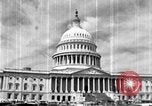
United States President Lyndon Johnson addresses the Congress at U.S. Capitol in Washington DC.
The United States Capitol building in Washington DC, United States. Officials standing in U.S. Capitol building. United States President Lyndon B. Johnson addresses the Congress. U.S. Constitution document with headline "We The People."
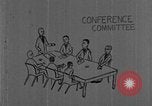
Describes how bills are reviewed by Congressional Committee, passed, and signed into law by the President of the United States.
A cartoon shows a Congressional Conference Committee. An actual Congressional Committee at work in the United States Capitol Building Washington DC. President Lyndon B. Johnson signs legislation into law. The President conveys the signed legislation by means of a signing document expressing his support for and reservations about it . His signature on the legislation. Copy of the final law as printed in the U.S. Code. View of the United States Capitol building.
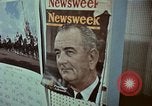
Washington Press Corps and news about President Johnson, after assassination of President Kennedy
U.S. President Lyndon B Johnson on the Cover of Newsweek magazine, December 9, 1963. Members of the Washington Press Corps covering news and events from the White House under the new President, Lyndon Johnson. Members of the Press pick up news releases and attend a news briefing in the White House. Views of many members of the press and media in conversation and during setup activities for a press briefing in the White House. Views of motion picture camera crews preparing cameras for the event.
Attack on Pearl Harbor by Japanese, and President Roosevelt asks for war declaration on Japan in 'date of infamy' speech.
United States Government film entitled "The World At War" dealing with World War 2. Film opens showing Japanese warplanes in formation above a Japanese military installation. Slate reads: "Pearl Harbor December 7, 1941. An airfield is seen filled with parked U.S. Army Air Forces B-17 bombers. Two Boeing XB-17 (Model 299) bombers are parked next to each other on the ramp. Derricks and ships are shown at the Pearl Harbor naval base. A formation of Japanese Mitsubishi G3M bombers is seen in flight. They are seen overhead as bombs explode on the U.S. Navy Air Station at Ford Island destroying hangars and aircraft. Next, is shown the famous image of the USS Arizona burning, listing, and sinking, after being bombed. Film continues, panning over post-air raid views of destruction. On December 8, 1941, U.S. President Franklin D. Roosevelt, addresses the Congress, delivering his declaration of war message. He calls December 7, 1941 "a date which will live in infamy." Roosevelt recounts that the United States was at peace with japan and in conversation with its government and Emperor, in the interest of maintaining peace.in the Pacific. even at the time of the attack. Japanese ambassador and his colleagues seen visiting State Department offices to meet with U.S. Secretary of State prior and even during the initial attack operations by Japan.Roosevelt recounts that the United States was still in conversation with Japan even at the time of the attack. Japanese ambassador and his colleagues seen visiting State Department offices to meet with U.S. Secretary of State prior and even during the initial attack operations by Japan. Photographers take pictures of the visiting Japanese delegation. President Roosevelt asks Congress to affirm that a state of War exists between the United States and the Japanese Empire.
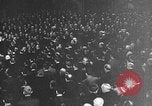
Varying sentiments about war and labor in lead up to World War 2. Roosevelt delivers his war message in the United States.
Disturbances and conflicting views about war versus isolationist approach in the United States prior to World War II. Officials speak about lend lease and officials with anti-war involvement stance advocate protectionism. Speakers include Senator Gerald P. Nye. and Senator Burton K. Wheeler. Wendell Willkie speak advocating a unified approach. Senator Joshua B. Lee of Oklahoma speaks. United States President Franklin D. Roosevelt addresses the Congress and delivers his war message. Pacifist student protestors on street in front of the White House with anti-war banners that read 'Peace Mobilization'. Counter demonstrators also picket, including a man with a sign, "We Americans Protest Communists Picketing the White House." Vehicles drive past in front of the White House. A group of women anti-war protestors are seen seated at an event, and together they pull down black veils in front of their faces. German Bund officials (German-American Bund) are seen meeting at an outdoor rally, and then again at Madison Square Garden in New York City in 1939. A band plays and the leader Fritz Julius Kuhn gives a brief speech during which a protestor leaps the stage and is beaten down by Bund members. Workers on streets protesting for various labor rights. They march and picket on a street. Demonstrators for other causes in American society in the early 1940s, including a woman demonstrator who carries a sign advocating civil rights or equal rights that says "Did Lincoln Free the Slaves?" Clip ends with scenes of violence at various labor strikes, including scabs (strike-breakers) being attacked, beaten, and hit by strikers, and authorities directing water hoses on strikers to repel them away from a building gate.
CRITICALPAST.COM: About Us | Contact Us | FAQs - How to Order | License Agreement | My Account | My Lightboxes | Shopping Cart | Advanced Search | Featured Collections | Website Terms & Conditions | Privacy Policy ©2026 CriticalPast LLC.
License Agreement |
Terms & Conditions |
Privacy Policy
©2026 CriticalPast LLC.