


 Francais
 Deutsch
 Italiano
Refine Your Search
D-Day stock footage and images
- Showing 1405 to 1410 of 4856 results more
more Hide
Hide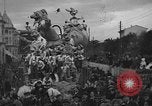
Floats of different forms featured in the procession of a carnival in Viareggio, Italy.
Carnival day in Viareggio, Italy. The town of Viareggio holds a Carnival street celebration a day before the beginning of Lent (a solemn period of penitential commemoration until Easter for Roman Catholics). A giant float with a giant papier-mâché effigy depicting an old man and a mouse moves along a road in the carnival. Men dancing on the float. Gigantic papier-mâché cartoon figures are on display in floats. A large group of people on both sides of the float move with the procession. Buildings on both sides of the road. Caricaturized African tribesmen effigies are displayed on a float. Men in stereotypical African costumes dancing on African float. Gigantic papier-mâché effigies moving mechanically on floats. Crowds gathered on the sides watch the procession. Several floats of different forms move in the procession. Men dancing while perched on floats. Papier-mâché effigy’s eyebrows moving upward mechanically.
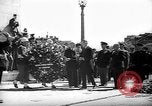
U.S. Ambassador to France Caffery at the Tomb of the Unknown Soldier in Paris and U.S. military cemetery in Suresnes in France.
Memorial Day in Paris, France. U.S. Ambassador to France Jefferson Caffery with officials. The ambassador lays a wreath at the Tomb of the Unknown Soldier. A guard helps the ambassador. The officer behind the ambassador salutes. The ambassador signs on a book. The wreath has a band across it which reads 'American Overseas Memorial Day Association'. U.S. military cemetery in Suresnes. American and French flags beside the graves. U.S. soldiers walk between the graves. U.S. troops march in the cemetery. Jefferson Caffery arrives with officials. U.S. Airborne Battalion marches in the cemetery. The soldiers stand at attention. They fire a volley over the cemetery. The Airborne Battalion stands in formation along a pathway. The officials review the troops. French and American troops march along a road during the parade. People on both sides of the road watch the parade. U.S. Ambassador Caffery and the officials salute. The Ambassador and the officials talking.
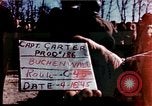
German civilians are shown the horrors of Buchenwald Concentration Camp in Ettersberg, Germany.
The liberated Buchenwald Concentration Camp in Ettersberg, Germany, 5 days after its liberation by American forces in World War 2. German civilians view the camp. American soldiers direct them. Two ladies holding hands enter. Huge crowd of civilians gathered at the camp. Bright sunny day. Reactions on faces of German civilians as they view dead inmates and victims of Nazi brutality and atrocities at the camp. Lines of dead bodies and other parts of human bodies at the camp. Some citizens console other German citizens while they cry.
A large crowd gathers for the funeral of Gestapo official, Reinhard Heydrich in Prague
The funeral of German SS Officer and Gestapo official, Reinhard Heydrich in Prague-Libeň, Protectorate of Bohemia and Moravia (now Prague, Czech Republic). Exterior view of the Church of Our Lady before Týn. A large crowd gathers in Old Town Square for the funeral. Citizens stand and sit, crowded atop the Jan Hus Memorial. A man at a dais addresses the crowd. A Nazi logo in the background of the dais. Buildings in the background. Dignitaries attend the funeral.

President Richard Nixon delivers "Nixon Shock" speech dealing with the economic crisis in the United States.
President Richard Nixon gives a speech on the economy from the White House in the United States. Nixon addresses the nation on the need to create more jobs, stop the rise in the cost of living, control price inflation, relieve economic stagnation, and control speculation. He announces the Job Development Act of 1971. He talks of eliminating excise taxes on automobiles and speeding up availability of some exemptions in personal income taxes. He charges Congress to introduce incentives for research and development. He orders federal spending cuts including a postponement of pay raises, a 5 percent cut in government personnel, and a 10 percent cut in foreign economic aid. He notes need to open ways for the young people entering job markets. Nixon orders a freeze on all prices and all wages in the United States for 90 days, and he calls on corporations to extend the freeze to dividends. He announces a Cost of Living committee within the government. He calls for voluntary cooperation of all Americans to control price increases after the 90 day period ends. He talks of the need to protect the strength of the American dollar and prevent international money speculation. He announces that the dollar will be defended. He announces the suspension of the convertibility of the dollar to gold, except in certain circumstances. (Later this speech was called the Nixon Shock and also the speech closing the gold window.) He says he wants to "lay to rest the bugaboo of what is called devaluation." He states the goal is stability in the dollar. Regarding trade balances, he announces a temporary 10 percent tax increase on goods imported into the United States, valid until unfair exchange rates are eliminated. He reflects on success of post World War 2 relief measures offered by the U.S. to foreign countries, increased competition with those nations, and need for less U.S. relief to them. He asks the public of America to work together to crush unemployment and economic problems.

Paul McCracken, an American economist, comments on the economic speech by U.S. President Nixon in the United States.
Discussion and analysis following U.S. President Nixon's speech on the economic crisis from the White House, United States. Reporter Bill Gill sits with Bob Clark, a White House correspondent, and economic advisor Paul McCracken. Both the reporters ask Paul McCracken to make a comment on the proposals of President Nixon dealing with the American economy (a speech later known as the "Nixon shock" speech). Paul McCracken speaks on the advantages of the 90 days wage-price freeze. He tells how to secure cost price level, how to control unemployment and inflation. He states the 90 days wage-price as the strongest economy program and how it will give foundation to more companies. He also speaks on dollar rate and foreign exchange and how to maintain its position, and the closing of the gold window.
CRITICALPAST.COM: About Us | Contact Us | FAQs - How to Order | License Agreement | My Account | My Lightboxes | Shopping Cart | Advanced Search | Featured Collections | Website Terms & Conditions | Privacy Policy ©2026 CriticalPast LLC.
License Agreement |
Terms & Conditions |
Privacy Policy
©2026 CriticalPast LLC.