


 Francais
 Deutsch
 Italiano
Refine Your Search
Greek-Civil-War stock footage and images
- Showing 907 to 912 of 27579 results more
more Hide
Hide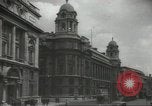
Sir John Dill, Dutch officers, and other officers enter the War Office building and meet in London during World War II.
Army officers enter the War Office building in London early during World War II. Exterior view of the War Office building (later the Old War Office) and traffic on Horse Guards Avenue in London. Dutch officers get out of car and enter the War Office building. Nelson's Tower at Trafalgar Square seen in distance. Sir John Dill, Vice Chief of the General Imperial Staff, enters the War Office building. Number of officers enter the building. Interior views of an office in the War Office building, with Director of Public Relations at War Office, Major General John Hay Beith, Richard De Rochemont and Maurice Lancaster seated in the office. The officials converse with each other.

Imperial Japanese Army (IJA) soldiers commit war atrocities and murder during World War II
Atrocities committed by Imperial Japanese Army (IJA) soldiers in China and other parts of Asia during World War II. War workers in offices, factories, and mills shift their attention to the narrator. Smoke rises from factory smokestacks and chimneys. American workers manufacture war materiel in factories. Factory workers shovel coal to the furnace. Japanese soldiers abuse elderly Chinese women. A Japanese soldier toss an infant before striking with a bayonet midair. A Chinese woman watches with shock. IJA troops drag and bury Chinese civilians alive. IJA troops burn cities and shoot victims at close range. Soldiers place the remains of dead Chinese men, women, and children in truck. Japanese soldiers torture and kill Chinese civilians and are depicted killing American Prisoners of War (POW). Aerial views of San Francisco, Chicago, Pittsburgh, and New York. A dead Japanese soldier with flies covering his face. A newly built M4 Sherman tank moves inside a factory. Body of a Japanese soldier wearing round glasses. Dead Japanese soldiers seen with repeating American wartime propaganda message that every piece of wartime production "kills a Jap." Tanks, trucks, planes, shells, guns, and artillery are manufactured in United States factories and plants during World War II. Americans urged to take war jobs to help win World War 2.
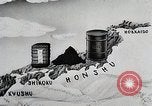
Japanese natural resources related to Second Sino-Japanese war and World War II
Animated map illustrating shortage of indigenous raw materials in Japan. As stockpiles vanish during Second Sino-Japanese war, Japan's domestic sources supply only 10% of the nation's needs for war. Animated sequence shows lack of steel, aluminum, copper, and power generation for the conduct of war. But one of the nation's greatest resources is the population of skilled Japanese workers, who are shown at various high tech jobs, as well as on the farms and in the fishing industry. Japanese workers are seen who work for the Zaibatsu (four ruling families of Japan). Banks of Japanese women typists and women in a factory. Young women painting faces on a "Kewpie doll." A Japanese family at dinner time. Women engaged in fabric spinning. Animated graphic illustrates Japan's war-related resources for World War 2, by showing a Japanese soldier standing astride map of Japan with lines extending to sources of needed raw materials from Japanese possessions in Korea, Manchuria,Formosa, China,Indochina,Malaya, and its network of Pacific Islands. Final scene displays copy of Los Angeles Times newspaper with headline reading: "Jap Supply Lines Blasted." It also features a story that appears to refer to the U.S. 6th Army invasion of Leyte in the Philippines, in October, 1944 (when General MacArthur waded ashore and stated,"I have returned"). (Note: Although produced during World War 2, this film shows prewar scenes of Japan. The animated illustrations and maps and, of course, the newspaper shown at the end, date from World War II.)
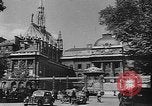
Politicians and numerous war crime trials in Europe after World War I and II.
Events and various war crime trials after World War I and II. Exterior view of Palais de Justice de Paris with some cars in front, in Paris, France. Courtroom views: Pietro Caruso, Fascist of Italy is seen in court. Next is Norwegian Army officer Vidkun Quisling in court. French General Henri-Philippe Petain in court in Paris. French politician Pierre Laval speaking in a court room. Views of lawyers and prosecutors speaking forcefully in courtrooms. Nazi Hermann Goering speaking in an outdoor setting. Nazi generals being arrested at end of World War II including Field Marshal von Rundstedt. Next scene shows Germany's Kaiser Wilhelm II and General Staff during World War I. Next is Briitsh Prime Minister Henry Lloyd George, after World War I. Kaiser Wilhelm II, residing in Doorn, Netherlands, after World War 1. With his good hand, the Kaiser throws wood into a pile. A post-war aerial view of Nuremberg, Germany with massive bomb damage and destruction in the city. The court house of Nuremberg. U.S. chief prosecutor Robert Jackson walking outside the Nuremberg courthouse with a military officer on his right and a woman on his left. Next scene is a dramatization of a British Court scene, with justices wearing powdered wigs. Elevated, wide view of Red Square in Moscow, Russia, Soviet Union. View of a Soviet court in session, and civilian viewers of the trial seen in upper gallery viewing seats.

Montage of scenes showing American civilian mobilization on the home front, life in the Navy, war scenes and demobilization after war.
View of a U.S. battleship heading toward the camera at high speed. Images of hip's wake becoming gradually more turbulent as camera focuses closer upon it in successive views. U.S. sailors in uniform. The first wears a the Silver Star medal. The next wears a Navy Cross medal. The third sailor wears a Cross medal with red and gold ribbon. A petty officer and two sailors posing together, each one displaying Cross and star medals, respectively. The scene fades to this last three, wearing civilian clothes in a flashback to the beginning of World War 2. The three watch as a draftsman lays out a Roll of Honor for a place called Middletown. Townspeople cheering at an outdoor sporting event. Next they sit and watch a tennis match. Next, many are seen as sailors scrubbing the deck of a battleship. Scene shifts to a Navy Wave guiding a C-45 aircraft into parking position. Another one is parked behind her. Next a "white shirt" on deck of an aircraft carrier is seen directing an aircraft with signals. A Douglas Dauntless aircraft is parked on the deck behind him. Abrupt change of scene shows a wounded sailor being attended by a physician. Members of a Navy ship's crew enjoying a swim, hanging out on a boom extended from their ship, and using rubber rafts and a dinghy as they enjoy recreational time allowed by the Captain. A sailor in a dining hall relishing a large piece of chicken. In contrast, a sailor at an antiaircraft station eats hastily. Twin guns are silhouetted behind him. Sailors getting dressed to go on shore leave. Photos of pinup girls displayed on locker behind them. They leave, but one sailor remains behind, on some kind of restrictions. Sailors on deck in formation as they are inspected by officers. One asks a sailor to adjust his hat and also examines his tie. A sailor sitting alone by a lake in Central Park, New York City. A sailor standing watch in setting sun. A chief Petty officer instructing a sailor on wearing his hat. Successive closeups of the imposing face of the Chief. that transitions into the face of a Lieutenant Junior Grade who is yelling at a sailor. Scene shifts to actual World War 2 battle footage scenes as Navy crew battles fire in an aircraft carrier's Island during naval combat in the Pacific. Hose lines are stretched across the flight deck and smoke envelopes the ship. Injured are carried to place of safety. Another scene aboard a U.S. Navy ship in World War 2, shows a Navy Chaplain praying over sailor who was killed, followed by a ceremonial burial at sea for the dead. U.S. Marines fire rifle salutes as coffins slide out from under American flags to carry the fallen sailor into the sea. As the nation demobilizes after the war, various "rabble-rousers" begin to cause trouble. One is seen speaking before a group of women, who seem influenced by his remarks. Scene shifts to aerial views from a low-flying airplane revealing the total destruction and rubble over miles of a German city, probably Berlin, from Allied bombing and shelling during World War 2. Views of suffering survivors of World War II (especially children) in various parts of the world. Emaciated and starving children in a war-torn area.
U.S. Women Army Corps march, and woman work in war production factories in World War 2 in the United States.
Contribution of U.S. women in the war effort in the United States during World War 2. U.S. troops fire a camouflaged artillery. Aircraft parked in a line. The aircraft take off one after the other. The aircraft in flight. A woman Marine looks through binoculars. Another Marine stands beside her. A ship underway in the background. The women Marine looks into documents. The members of the U.S. Women Army Corps (WAC) at work. Women war production workers in war production factories and machining factories make tools to help with the war effort. A woman worker operates industrial equipment. American soldiers carrying supplies embark a ship. Animated map shows the location of Berlin and Tokyo. The women walk in a group. A woman speaks to a man at an office. The Women Army Corps (WAC or WACC) march on a street. Buildings in the background. Narrator asks women to join the war effort as war workers or by joining the armed forces. The women march. The troops fire guns. Smoke rises due to explosion. The areas where women are needed.
CRITICALPAST.COM: About Us | Contact Us | FAQs - How to Order | License Agreement | My Account | My Lightboxes | Shopping Cart | Advanced Search | Featured Collections | Website Terms & Conditions | Privacy Policy ©2026 CriticalPast LLC.
License Agreement |
Terms & Conditions |
Privacy Policy
©2026 CriticalPast LLC.