


 Francais
 Deutsch
 Italiano
Refine Your Search
Greek-Civil-War stock footage and images
- Showing 901 to 906 of 27579 results more
more Hide
Hide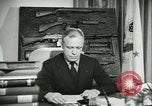
United States Undersecretary of War Robert P. Patterson speaks on the value of war materiel production in the United States (WW2)
United States Undersecretary of War Robert P. Patterson seated at a desk in his office. He addresses the nation and speaks on the value of war material. Patterson talks about production of ammunitions and supplies in the industries of the war department. “The demands of war is insatiable. We will never be satisfied as long as the war lasts,” Patterson said. Railroad train in snow. POV train engineer looking out snowy landscape. Production of war materiel in the United States during World War II. Steel mill operations with ingots being formed from hot metal. A sheet of hot metal emerges from a machine. Women war production workers sort and inspect aluminum sheet metal. Ships carrying supplies sailing an ocean. Crowds of factory workers walking outside war production factory in the United States. Trucks driving on mountain road.
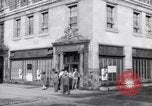
People from all walks of life switch to war work in Dayton,Ohio during World War 2.
Residents of Dayton Ohio, transfer from ordinary pursuits to perform war-critical work in World War 2. Men and women are seen lined up inside offices of the United States Employment Service (USES) in Dayton, Oho. All prospective male workers are cleared through the USES. Certain occupations are reserved for women only. Women doing needlework in their homes, switch to war work instead. One is seen filing a part in a factory. A soda jerk takes on work in a machine shop. A bootblack shining shoes, ostensibly moves into war work. Back, inside the U.S. Employment Service offices, representatives of defense plants set up tables and hire prospective workers on the spot. Workers leaving a Dayton war plant during a shift change. Cars and pedestrians during regular shopping hours in a local town. View of a downtown commercial district. The Manpower Emergency Committee in a meeting. New Store hours are posted for various businesses. A newspaper announcement of special store night hours for war workers. A company poster listing "Victory Store Hours." Dayton stores and shoppers conducting business after dark on nights when shops were open for war workers. Views of shoppers patronizing various retail stores, including a McCrory 5 and 10 cent store, a market store, and a department store. Late shift workers in line at banks to see bank teller and cash pay checks. A soldier in uniform sitting with a woman shopping for new shoes. Workers in a ladies beauty salon or hair salon, and in a men's barber shop, working during night time hours to serve war production workers. Night time recreation programs for workers show workers with musical instruments standing in line, theatre marquees advertising late night shows and movies, with signs advertising Red Skelton and Eleanor Powell among featured stars. Women bowling at a bowling alley, overhead view of couples dancing the lindy hop while a crowd watches, other scenes of couples dancing on dance floors.
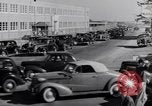
City of Dayton Ohio takes numerous measures to improve transportation and amenities for war workers during World War II
Opening scene shows workers arriving for a shift at a war plant in Dayton, Ohio, during World War 2. The arrive in cars and public transport (not seen) to stream across the road in front of the defense plant, as they enter. Others are seen leaving defense plants, in large numbers as their shifts end. A sign at a war plant advocating ride sharing or car pooling to conserve resources shows a cartoon of Adolf Hitler riding in the empty back seat of a man's car. It reads, "Hitler rides in the empty seat. Double Up!" Men and women are seen standing at a designated Transportation Center to arrange for sharing rides with others. A man steps from a sidewalk, in town, to get into a car that stops to pick him up as part of that activity. People gathering for buses under newly built shelters. A sign on a bus reads: We deliver the war workers. They deliver the goods." Buses moving through the city. One stops and many workers exit, in a town center. Other workers are seen lined up to board rail road trains. Workers entering their private cars in a crowded parking lot at a war plant. Workers crowd into the entrances of a defense plant, where their identification badges are evident on their work clothes. Large numbers of workers leave at the same time others arrive when a shift change occurs. Plant managers discuss ways to minimize absenteeism. View of workers in a crowded cafeteria providing hot meals. A sign reading: "Ladies Dining Room." outside a room filled with women workers having a meal. Men at work in a National Cash Register (NCR) factory assembling 60 pound magazines for 20mm Oerlikon anti-aircraft guns, used by the U.S. Navy, and built by National Cash Register in Dayton Ohio. A factory steam whistle blows, signaling a rest period, as workers take a break for a snack or a smoke. Worker eats an apple and other smoke cigarettes. Narrator describes health and logistical services offered on-site at production plants for workers to minimize time away from work. A sign on a door identifies the "Ladies Health Department." Hours posted on the door correspond to various shifts operating at the plant. Another worker health service is that of a dentist on the premises. View of dentist and nurse working on a patient. Another service area in a war plant shows clerks helping workers to obtain ration books, auto and driver licenses, dealing with Selective Service (draft) matters, income tax questions, ride sharing, and telephone and light utilities. Scene shifts to the Headquarters Building of the National Cash Register Company in Dayton. Ohio Inside, a company manager is interviewing a worker who plans to quit. They discuss the workers reasons and seemingly resolve some problem, because they shake hands and the film narrator implies that the worker is going to remain on the job. A factory building lit up at night. Inside men and women night shift workers are seen performing war work on machines, just as in the daytime. Next, a group of plant managers are seen being trained in particular skills required at their jobs. A view of the city from across a river. A radio announcer with station WHIO. A montage of newspaper clipping related to war workers.
Germany in years leading up to World War 1 and during World War I
Traces events leading up to and through World War I. Portrait of German emperor Kaiser Wilhelm II. Wilhelm II riding on horseback. He starts the preparations for war. Views of German military officials including Helmuth von Moltke the Younger. Newspaper headlines of assassination of Austrian Archduke. Celebrations on streets of Germany at start of World War I including views of German soldiers and citizens preparing for war. Germany launch war on Serbia, France and England. German infantry and u-boat submarines target enemy positions. U.S. President Woodrow Wilson in his office . U.S. declares war on Germany. U.S. forces departing from American cities and arriving in Europe; moving toward battle. Scenes from trench warfare of World War I in France. Soldiers going up "over the top" out of trenches during offensive operations and into "no man's land". Retreat of Germans, views of General von Luddendorff, the German Chief of Staff. Armistice declared after secret message sent to German government by Luddendorff. Cheering people celebrate the end of World War 1 after armistice. Views of United States General Pershing.

Trials of war criminals in Germany after World War Two. Belsen local trial.
"The Guilty." Animation depicts person being hanged. View of an angry crowd on a road. People beat captured German soldiers and collaborationists. Mob of Italian partisans in Italy raising dead bodies of Mussolini and others up to hang from their heels in public after their execution. Foreign Minister Vyacheslav Molotov and British Foreign Secretary Sir Anthony Eden signing the Moscow Declaration in November, 1943. The declaration is signed to preserve the authority of law in Europe and to ensure fair and orderly trials for war criminals. Next scene shows Allied soldiers at a liberated Concentration Camp near the end of World War 2 in Europe. Military jeeps in the background. Military photographer takes pictures as officials arrive to tour the concentration camp. Man opens a crematorium oven, revealing bones of a corpse inside. Pile of dead victims of a concentration camp. Elevated view of a room full of documents that are in review for war trials. Officials search documents to identify war criminal suspects. Nazi officers and officials who committed suicide are shown, including a German admiral, the body of Heinrich Himmler, and the bodies of the Mayor of Leipzig and his wife. War criminals being summoned for the various war crime trials. Scenes from the Belsen Trial in September 1945, held in a Lüneburg gymnasium, to decide the fate of German guards and SS officials from the Auschwitz and Bergen-Belsen concentration camps. A defendant being brought to trial on a stretcher. Soldiers guard the court room. View of defendants including many women SS-Gefolge members. German Commandant Josef Kramer during his trial, and German doctor Fritz Klein beside him. The court trial underway for the war criminals. Guilty war criminal brought to the gallows to be hanged, black cover placed over his head and he is hanged. View of dead bodies of concentration camp victims. View of a crowd amassed at a hanging execution of several German officers, possibly in the Soviet Union.
War industries lead to overcrowded cities and housing shortage in Mobile, Alabama; also pre-war poor housing in Mobile
Views of old Mobile Alabama downtown areas and homes during early 1940's. War industry leads to problems in Mobile, Alabama during World War II. Buildings in the city which now have been converted into homes for men war workers and women war production workers in the shipyards and factories making ships and airplanes, tanks, guns and other war material. A building converted into a dormitory for women. Men outside a building with a sign that reads ' Room board '. Girls in a room. A garage that has been converted into a boarding facility for women war workers. A tent area with a large number of migrant worker families living in it. Children play outside the tents. A woman washes clothes. A man cooks. A woman stands next to a cow and a man sits with his dog outside a shanty house. Next scene is pre-war view of dilapidated and run-down shacks housing African American families in Mobile. African American men, women, and children outside shanty houses in slum areas of Mobile. Scene changes to during war time again, with people at the office of the National Housing Agency. A sign reads ' Mobile housing board'. People at the office of the housing board.
CRITICALPAST.COM: About Us | Contact Us | FAQs - How to Order | License Agreement | My Account | My Lightboxes | Shopping Cart | Advanced Search | Featured Collections | Website Terms & Conditions | Privacy Policy ©2026 CriticalPast LLC.
License Agreement |
Terms & Conditions |
Privacy Policy
©2026 CriticalPast LLC.