


 Francais
 Deutsch
 Italiano
Refine Your Search
M4-training stock footage and images
- Showing 7177 to 7182 of 8218 results more
more Hide
Hide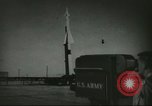
Atomic bomb scenes WWII; atomic testing at U.S. Army atomic experiment station 'Camp Desert Rock' in Nevada, United States
Episode of "The Big Picture", a U.S. Army series of news release programs. U.S. Army cameraman recording Nike missile launch. Atomic cannon fires shell creating atomic explosion and classic mushroom cloud.. Army troops spill out of Sikorsky YH-19 helicopters. U.S. Army infantry soldiers ascend hill firing their rifles. Atomic experiments at Camp Desert Rock in Nevada, United States. U.S. Army Master Sergeant Stuart Queen seated at a desk in his office. He speaks about a series of atomic experiments ("Desert Rock 6") held in barren lands of Nevada at Camp Desert Rock. Celebrating victory in Europe, during World War 2, American troops parade down the Champs Elysees in Paris, France, with the Arc de Triomphe behind them. Happy Parisians watch the parade. War scenes in Japan: footage of explosion and mushroom cloud rising after atomic bomb blast over Nagasaki on August 9, 1945. Barren land on the ground in Hiroshima after the August 6, 1945 atomic blast there . B-29 bombers in flight. Atomic bomb test detonation. Atomic artillery gun M65, also called the Atomic Cannon or Atomic Annie, fires and creates nuclear explosion on distant target.Viking missile launch. U.S. soldiers on parade. Headquarters sign at U.S. Army atomic experiment station at Camp Desert Rock, Nevada, displaying 6-pointed star with "A" in center.. Several atomic test explosions. Soldiers on hillside witness a non-nuclear explosion. Buses carry troops along a road past a sign warning of radiation hazard. Army captain, instructor, briefing troops before the start of atomic maneuvers.. Maps of planned maneuvers. Engineer surveyors lay out ground zero target. View of the ground zero area which is the target area for testing. Signal men lay communication lines to receive and transmit teletype messages. Men operate machinery and dig trenches in which troops will take cover. Other men cover them with sand. [Note: According to the U.S. Department of State, Office of the Historian, from February 18 to May 15, 1955, the United States conducted Operation Teapot, a nuclear test series at Yucca Flat and Frenchman Flat on the Nevada Test Site in the continental United States. During the test period 14 nuclear shots and 1 non-nuclear shot were detonated. Several thousand scientific, military (army, air force, navy, marines), and civilian contract personnel participated in the organization, planning, and execution of the test series. Military exercises undertaken during and following the shots took place under the name Desert Rock 6.]
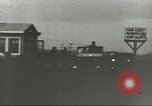
Preparations for the "Apple Two" atomic test shot and associated U.S. Army's "Desert Rock VI" exercise, at the Nevada Test site
The U.S. Army prepares for its "Desert Rock 6" atomic maneuvers and tests , as part of Operation Teapot atomic tests in 1955. U.S. Army troops in trucks, pass through entry gates, headed for ground zero of atomic test shot "Apple 2" , the 13th in this series, scheduled for May 5, 1955, at the Nevada test site. A soldier with clipboard notes their passing. Next, the Control Center Building is shown. It displays several types of antennas. View from inside the building. Vehicles moving in area near the control center. Low-level aerial view of the "ground zero" area. Men walking into a bunkered shelter housing instruments for measuring atomic explosion data. View upward from ground, of instrumentation being setup on a steel tower outdoors. Glimpse of a soldier who will be participating in the exercise. A technician adjusting instruments atop the steel tower. Soldiers walking into ground zero and inspecting an artillery piece there to determine the planned explosion's effects on it. Other things placed in the area to determine effects atomic explosive effects on them include: sand-bagged emplacement; a jeep (labeled, Test Equip. off limits); a 155mm howitzer; A Browning heavy machine gun; portable field radio; trench mortar; simulated soldiers, including steel helmet and rifle; trees; an unsheltered North American B-45 tornado aircraft; and Republic P-47 aircraft in both sheltered and dug-in positions. Workmen are seen erecting buildings in a model village (including mannequins representing occupants and food to be tested). M-48 Patton tanks and their crews, part of "Task Force Razor" are seen raising dust as they travel across deserts to the Nevada test site. Army soldiers performing maintenance on their tanks and equipment prior to entering the test site. More trucks and equipment approaching the test site.
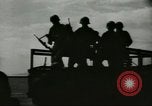
U.S. Army conducts exercise Desert Rock VI, as the "Apple 2" atomic explosive test shot is fired at the Nevada test site
U.S. Army troops silhouetted against sky at dawn as they step from trucks and then proceed to their protected positions in area of ground zero prior to the "Apple II" atomic explosive test shot, "Apple Two," associated with the Army exercise Desert Rock 6. They enter sand-bagged trenches. A briefing officer in a trench issues final instructions that are broadcast over a loudspeaker. View of desert dry lake bed, beyond which is ground zero (detonation site) about 5 miles away. Soldiers are seen foxholes and trenches. An M48 Patton tank, of Task Force Razor is seen, with a tank commander speaking to his group by radio. He instructs them to shut down engines, close all hatches and turn turrets to the rear. Views of tank crew members inside their tanks. The Commander goes down closing his hatch behind him. Other tank crews do likewise. Two Soldiers seen waiting in a trench. One smokes a cigarette. Others standing in their trench. At H-Hour minus two minutes, a siren blows and all begin taking protected positions deep within their trenches and foxholes, as instructed over the loudspeaker. Views of some soldiers in their positions. Glimpse of jeep and of B-45 bomber sitting unprotected on the desert. View of P-47 aircraft in protected positions. Several trees in a line. White flash fills screen as the atomic device is detonated. The explosion seen through camera filming through a porthole. A building flashes into flame and then is blown over by blast wave or shock wave. Interior of house containing mannequins seen, as windows burst in flames and then blast destroys it. Other buildings being swept away. A steel tower bending but remaining upright. Troops out of their trenches moving forward toward ground zero, as the mushroom cloud forms in the distance, and a helicopter flies overhead. Patton tanks of Task Force Razor move toward ground zero, "fighting" their way through obstacles. [Note: According to the U.S. Department of State, Office of the Historian, from February 18 to May 15, 1955, the United States conducted Operation Teapot, a nuclear test series at Yucca Flat and Frenchman Flat on the Nevada Test Site in the continental United States. During the test period 14 nuclear shots and 1 non-nuclear shot were detonated. Several thousand scientific, military (army, air force, navy, marines), and civilian contract personnel participated in the organization, planning, and execution of the test series. Military exercises undertaken during and following the shots took place under the name Desert Rock 6.]
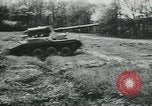
U.S. experimental tank undergoing field test. Army instructors explain new weapon systems. Captured German rockets.Soviet parade
A U.S. experimental tank undergoing field tests in the United States. Soldiers test weapons on a field. An officer demonstrates use of mortar. A flame thrower being fired. Instructors explaining new Army weapon systems. U.S. soldiers pull a captured German V-1 buzz bomb from a shed, for testing. A captured German V-2 rocket is rolled out for testing. The rocket is launched successfully from a launch pad. Soviet Leader Joeseph Stalin and Foreign Minister Minister Vyacheslav M. Molotov together, with two Soviet Generals,are seen on a reviewing balcony, above Lenin's tomb, as they watch a Military parade in Red Square, Moscow. Soldiers holding guns march through streets. Tanks and missiles mounted on flat cars move. Buildings in the background. Russian revolutionary Vladimir Llyich Lenin's poster on a wall.
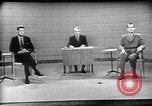
Senator John F. Kennedy and Vice President Richard Nixon face off in their first Presidential debate, in Chicago Illinois.
The first Kennedy-Nixon Presidential Debate in Chicago, Illinois. Moderator Howard K. Smith introduces the candidates-- Republican candidate U.S. Vice President Richard M. Nixon and Democratic candidate Senator John F. Kennedy. He talks about the opening and the closing statements to be given by the candidates. He talks about the questions which the panel of correspondents would ask the candidates. Senator Kennedy begins his statement. Kennedy talks about the direction of freedom for the Americans. He discusses domestic issues and the kind of society people live in. He talks about the strengths and the progress rate of the Americans. He urges people to make their country more powerful in every field. He feels disappointed about the unused steel-mill capacity, low rate of economic growth and poor educational system. He says he's not satisfied when he sees men like Jimmy Hoffa in charge of the largest union in the United States, and still free. He insists on overall infrastructural development and improvement of hydro power production where he says the Soviet Union has a lead. He states that every American should enjoy his full constitutional rights and they should meet their responsibilities. He says African American and Puerto Rican babies have much lower chances in education, work ,and advancement in the United States, and that this needs to change. He states that the government should provide effective programs and social security system for its citizens.
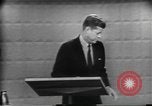
Nixon talks about the increase in GNP and average family income during the presidential election debate in Chicago, Illinois.
The first Kennedy-Nixon Presidential Debate in Chicago, Illinois. Moderator Howard K. Smith invites Republican candidate U.S. Vice President Richard M. Nixon to give his opening statement. Nixon begins his statement. He talks about the huge competition faced by the United States. He states that he disagrees with Kennedy's statement on the poor growth in national product. Instead he states that there has been a 6% growth of Gross National Product (GNP) in the past years. He compares the overall development of the country during the Truman Administration and the Eisenhower Administration. He states that there has been a continuous progress in the field of education, hydroelectric power, hospitals and highways. He discusses the improvement in Gross National Product and the average family income. He discuss effective plans and programs in the every field. He compares the effective styles of spending of the Federal government and the Democratic government. In his final point he states that his disagreement with Kennedy is not about the goals for America but only about the means to reach those goals.
CRITICALPAST.COM: About Us | Contact Us | FAQs - How to Order | License Agreement | My Account | My Lightboxes | Shopping Cart | Advanced Search | Featured Collections | Website Terms & Conditions | Privacy Policy ©2026 CriticalPast LLC.
License Agreement |
Terms & Conditions |
Privacy Policy
©2026 CriticalPast LLC.