


 Francais
 Deutsch
 Italiano
Refine Your Search
New Mexico United States 1946 stock footage and images
- Showing 26347 to 26352 of 30777 results more
more Hide
Hide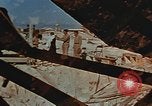
U.S. Navy and Marine personnel recover after the battle of Midway in World War II
Recovery actions by U.S. Navy and Marine personnel in the wake of the Battle of Midway in World War 2. Opening scene shows religiious services being held by a bomb crater that had once been a chapel on Midway Island. That evening, marines are assembled near flag-covered coffins of fallen comrades, in a burial ceremony. A marine chaplain conducts a funeral service, as Marines stand, with their rifles, at parade rest Several views from different perspectives of the event. An honor guard fires a volley with rifles. The American flag is at half staff, in the background. Among the officers seen is Marine Major James Roosevelt, son of the U.S. President, Franklin Roosevelt. Next, Navy boats are seen offshore, carrying the fallen for burial at sea. U.S. Navy aircraft fly in formation overhead. A marine scans the sky with binoculars as dense black smoke continues to billow from the petroleum facility bombed by the Japanese several days ago, and hangs like a pall over Midway Island. The American flag on a tall pole, is highlighted against the black smoke. Film ends with series of Slates summarizing Japanese losses in the Battle of Midway. The first shows 4 Japanese Carriers sunk. It is painted over by a brush containing red paint. Another slate announces 28 Japanese Battleships, Cruisers, Destroyers sunk or damaged. A paint brush places a large black cross over that slate. A final slate states 300 Japanese aircraft destroyed. The red paint brush appears again, but this time it marks a big “V” for Victory across the slate.
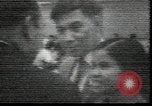
Trinidadian-American Stokely Carmichael talks about struggle of Blacks in the U.S. at Havana Press Conference in Havana, Cuba.
Press conferences in Havana, Cuba. Officials and dignitaries arrive to attend Havana Press Conference on August 2, 1968 and Havana Libre Hotel Press Conference on August 6, 1968. The officials and dignitaries seated at a table for the press conference. Trinidadian-American Black Activist Stokely Carmichael at the Havana Press Conference. Stokely Carmichael talks about the struggle of Blacks (African Americans) in the U.S. in order to attain liberation and get equal civil rights, and states that American Blacks will not fight in Vietnam. Stokely Carmichael talks about the constant aggression faced by the Black population, and gives a brief explanation of Black Power. Local reporters and foreign correspondents make notes during the conference. A newsman speaks.
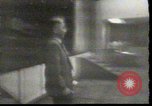
The letter written by the Black Activist Carmichael to Argentine Marxist revolutionary Che shown on Cuban TV in Havana, Cuba.
Trinidadian-American Black Activist Stokely Carmichael's letter shown on Cuban TV in Havana, Cuba. The letter written by Trinidadian-American Black Activist, Stokely Standiford Churchill Carmichael to Argentine Marxist revolutionary, Ernesto "Che" Guevara. The letter states that African-Americans in the U.S. admire Che, and Che is the inspiration for the Blacks inside the U.S. and to the civil rights and liberation struggle around the world. The letter is presented on Cuban TV, which was written on August 2, 1968.

B-25 bomb at Brest, Canadian troops advance, civilians buy goods and U.S. soldiers secure voting cards in France (WW2)
Normal life of civilians resume after German surrender in some parts of France during World War II. Aerial view of flak in sky. Close-up view of two U.S. Army Air Force B-25 Mitchell bomber aircraft in flight. (Narrator incorrectly states they are British Lancaster bomber aircraft.) View from bomb bay doors of bombs away shot as the B-25 bomber aircraft drop bombs on U-boat pens at Brest. Explosions and smoke rise. The aircraft drop bombs over ground installation over enemy area. Canadian soldier scenes: Troops advance through a burning coastal town in France. Buildings collapsing and gunfire in streets. Smoke rising. Ruins of destroyed French town are seen. Allied Army tanks advance and fire artillery. German prisoners of war from Wehrmacht 7th and 15th armies being marched under watch by Canadian forces. Among the German prisoners is a 13 year old Russian boy who was forced to work by the Nazis. German prisoners in a soup line and seen drinking from mugs. Some appear to be very young boy soldiers. U.S. Army soldiers in Le Mans: American soldiers are welcomed by civilians of France. Happy French civilians waving to U.S. forces including a happy young woman who runs forward and pats a U.S. Army tank with her hand. Men and women collaborationists who assisted the Germans are rounded up by French and marched away. U.S. Army soldiers seated at stools in a French bar drink as the bar maid pours more into their glasses. French civilians line up at shops and groceries to buy food and goods in Le Mans. Pictures of General De Gaulle for sale. American women in U.S. Army uniforms (possibly nurses or Womens Army Corps WAC members) look in shop windows at French fashions. Voting cards: U.S. Army troops read pamphlets that read "requirement of soldiers to vote" and "Soldiers Voting". The U.S. Army GI's receive and mail postcards to their homes requesting absentee voting ballots for the upcoming November 1944 election. The soldiers line up to secure their application cards for absentee ballots.
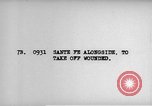
USS Sante Fe (CL-60) evacuates wounded from USS Franklin (CV-13) after Japanese bomb strike, WW2
Slate begins film reading: Sante Fe alongside to take off wounded. (Refers to the U.S. Navy light cruiser USS Sante Fe (CL-60) evacuating survivors from the aircraft carrier USS Franklin (CV-13) after it was bombed by Japanese aircraft during World War 2.) View of the Sante Fe starboard of the Franklin. Survivors are watching from the forward section of the Franklin as wounded are transported to from the Franklin to the Sante Fe by bos'n chair and similar means for transporting wounded on cots. Aboard the Franklin, sailors help an ambulatory wounded to a place where medics are giving first aid. They help him to a bed, of sorts that a medic quickly prepares on deck. Sailors passing a wounded to others who prepare him for evacuation. Back on deck, medics are tending to some wounded, bandaging injuries and preparing bed-ridden for evacuation. Intervening slate reads: Most terrific blast of morning.(Note; all explosions are made from ships distant from CV-13. Impossible to shoot film aboard during detonations.) (Indicates that subsequent scenes are filmed from other ships.) Distant views of huge fire ball and dense smoke coming from the USS Franklin. Slate reads: Sante Fe returns. Had been forced by explosions to shear off The Sante Fe seen starboard of the Franklin and closing with her fire hoses directing streams of water on the Franklin. Water running off the Franklin's deck. Small fire seen below decks. The Sante Fe inundating the Franklin with water from her hoses. View of aft deck of Franklin in pieces. Slate intervenes stating: Until dark Father O'Callahan, paying no heed to explosions and his own great peril attends the dying. Glimpse of sailors hauling lines on the Franklin flight deck. Then, Navy Chaplain, Father Joseph Timothy O'Callahan, is seen administering last rites to a dying sailor on the deck.

Fan dancers gather at convention and perform in San Diego, California.
Fan dancers gather at convention in San Diego, California. Fan dancers gather at convention to form the Western Federation of dancers. Fan dancers perform. Audience watch the dance and cheer the participants of their states.
CRITICALPAST.COM: About Us | Contact Us | FAQs - How to Order | License Agreement | My Account | My Lightboxes | Shopping Cart | Advanced Search | Featured Collections | Website Terms & Conditions | Privacy Policy ©2026 CriticalPast LLC.
License Agreement |
Terms & Conditions |
Privacy Policy
©2026 CriticalPast LLC.