


 Francais
 Deutsch
 Italiano
Refine Your Search
Tontouta New Caledonia 1943 stock footage and images
- Showing 199 to 204 of 10521 results more
more Hide
Hide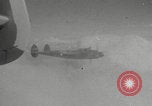
United States Army Air Force Lockheed P-38 Lightning aircraft of the 339th Fighter Squadron in flight formation during WW2
A fleet of Fighter-Bomber aircraft (Lockheed P-38 Lightning) of the United States Army Air Force in flight over the South Pacific Ocean during World War II. The 339th Fighter Squadron of the United States Army Air Force intercepted and shot down Imperial Japanese Admiral Isoroku Yamamoto in 1943. Three Lockheed P-38 Lightning fly together. One by one, the three aircraft tilt to the right downward. A fleet of Lockheed P-38 Lightning flying in formation near the clouds as seen from an aircraft’s side window. Three Lockheed P-38 Lightning aircraft went up to a higher altitude vertically in unison.
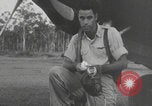
United States Army Air Force 339th Fighter Squadron Pilots in the South Pacific preparing for take-off during WW2.
The United States Army Air Force pilots of the 339th Fighter Squadron, who intercepted and shot down Imperial Japanese Admiral Isoroku Yamamoto in 1943 during World War II. Captain Tom Lanphier, is seated under an aircraft, cleaning his goggles. View of Captain Lanphier, smiling. Another United States Army Air Force Pilot, Lieutenant Rex T. Barber, wearing helmet and goggles, adjusts his straps. Another pilot, Lieutenant Besby Holmes, leaning his back on an aircraft, adjusts his helmet and laughs. Lieutenant Douglas S. Canning puts on a life vest and smiles. Lieutenant Delton Goerke chews and smiles as he looks at the camera. Lieutenant Julius Jacobson adjusts his helmet and smiles. Pilot in cockpit gives an “OK” hand gesture facing the camera before closing the cockpit canopy. Another pilot salutes facing the camera before closing his cockpit canopy.
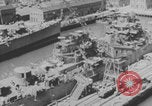
Naval guns and torpedoes manufactured, USS Wisconsin launched (WW2)
Steel used for ship building and war materiel manufacture in the United States during World War 2. Shipbuilding at a dock. Sign says “U.S. Naval Advance Base Depot”. A steam locomotive pulls a 16 inch naval gun from a war production factory. Men move newly made Navy torpedo via overhead conveyor. Men building torpedoes in a factory. A huge engine is being lifted by an overhead crane. War production workers on factory floor building items for U.S. Navy. A United States Naval officer speaks with a factory executive. Narrator mentions importance of scrap metal for use in ship building. The launching of the Iowa-class battleship, USS Wisconsin (BB-64), in the Philadelphia Navy Yard on December 7, 1943. Assisted by Rear Admiral Melo F. Draemel, Mrs. Margaret Roche-Goodland, wife of Wisconsin Governor Walter S. Goodland, successfully breaks a bottle of champagne over the ship's bow. The USS Wisconsin starts down the dry dock during launch.
Bodies of Polish victims and their personal effects during the exhumation of mass grave in Katyn Forest (WW2)
Bodies of Polish victims of the 1940 Katyn massacre during World War II. A corpse found from the 1943 exhumation of the mass grave. More remains of Katyn massacre victims. Exhumed corpses lie on the ground. A man shows the corpse of a Polish military officer. Men digging and carrying a corpse on stretcher. A man uncovers a corpse. The man inspects the corpse’s wallet for identification. Polish banknotes and identification papers on wooden table. Pictures of family members and identification cards belonging to Katyn massacre victims. Thousands of corpses exhumed in Katyn Forest. The Red Cross flag is also seen.
Lt. Col. James Doolittle directs the Doolittle Raid on Japan and receives an award from Madam Chiang Kai-Shek.
From a 1943 newsreel covering the Doolittle Raid on Japan in April 1942. United States Navy aircraft carrier USS Hornet (CV-8) in Japanese waters. B-25 Mitchell medium bomber planes lined up on the deck of the carrier. Lt. Col. James Doolittle and Hornet skipper Captain Marc A Mitscher with the 80 volunteers seated near a 500lb bomb on board. He ties a Japanese medal (awarded to U.S. officers for humanitarian aid to Japanese people) on the bomb. The carrier in heavy seas 800 miles off the Japanese coast. A Japanese patrol boat is sighted and sunk. The survivors are taken prisoners. The crew readies the loaded bombers. General Doolittle in the cockpit as he leads the takes off. The planes take off in rough weather to bomb Japan. The Yokosuka Naval Base bombed and ablaze. The planes bomb armed plants, rail yards and oil refineries all over Japan. Soldiers examine a wrecked B-25 in Japan. U.S. pilots hold traditional Chinese umbrellas and pose with a Chinese man. Chongqing: Soong May-ling, better known as Madame Chiang Kai-shek, awards General Doolittle and his men for the gallant raid. (World War II period).
Army Signal Corps receive and send messages via various methods in World War II; Pentagon signal center operations.
The role and contribution of the U.S. Army Signal Corps in combat during World War 2. Submarine cables laid down by the Signal Corps. Soldiers operate field army communication equipment for communication within and between units. Soldiers talk over the radio in a military jeep. American soldiers employ communication equipment seated at a table in a camp. A U.S. Army Signal Officer goes through documents. An officer receives a message in Washington DC. The message is relayed from the State Department to the Signal Center in the Pentagon building. Exterior views of the Pentagon building circa 1943 or 1944. Inside the Army Communications Signal Center in the Pentagon, technicians work using various communication equipment. They receive messages punched on tape as the tapes emerge from machines. Workers encoding and decoding secret and confidential messages that run the war. Workers at the 'Traffic Control, Army Command and Administrative System'. Paper messages seen gliding across a track near the ceiling above a signboard. A man inserts and removes cables from switchboard slots. The plans are then passed on in code through a maze of antennas all over the world. An animated map depicts the sending of these messages by radio multi-channels, radio teletypes, and manual radios to the front lines. A vast network of Army communication system from Washington DC to the rest of the world to carry a message around the world in three and a half minutes.
CRITICALPAST.COM: About Us | Contact Us | FAQs - How to Order | License Agreement | My Account | My Lightboxes | Shopping Cart | Advanced Search | Featured Collections | Website Terms & Conditions | Privacy Policy ©2026 CriticalPast LLC.
License Agreement |
Terms & Conditions |
Privacy Policy
©2026 CriticalPast LLC.