


 Francais
 Deutsch
 Italiano
Refine Your Search
US-Gliders- stock footage and images
- Showing 907 to 912 of 21920 results more
more Hide
Hide
U.S. troops show their ingenuity by designing new improvised gadgets (WW2)
A World War II documentary titled ' Yankee Noodle' depicts improvised devices and techniques used by U.S. troops to save time. Aircraft parked in a line at an aircraft industry. A man operates washing machine. Men at work on a granite launcher. A man operates a grappling wire used to trip mine. A man holds a cable binder used to put a line. Men on an elephant and put a wire. A man uses oxygen tank and a copper tube being coiled inside an oil drum for making a still for distill water. The water comes out from the tank and used for the battery. Men put the water in the battery. A U.S. aircraft lands. A man works on a gadget that takes only 20 minutes to change the tire of an aircraft. A tire loaded in a trolley and being pulled by a jeep. Three men load tire. Men hold a winch designed to tighten nuts and bolts. Mobile service and repair unit mounted on a truck. Instrument panel mounted behind the driver seat. Men at work on 110 volt generator. A work light, electric grill. A parachute used as an emergency brake for an airplane.
U.S. Army provides aid and assistance to South Vietnamese people in support of Republic of Vietnam Development Program
The U.S. Army providing military security in Vietnam to facilitate the Republic of Vietnam Revolutionary Development Program during the Vietnam War. U.S. Army tanks on the move. Vietnamese village on a river, with small boats at the bank. Irregular volunteer with M-16 walks over small bridge. Republic of Vietnam representatives in a rural village trying to win allegiance of the people with simple social and economic projects. Seen are persons providing health assistance, supervising small construction activities, and teaching school. U.S. Army officers advising Vietnamese officers as they consult a large map in a headquarters. U.S. Army advisory team listens as Vietnamese officer explains an agricultural project in rural Vietnam. District Advisor, a U.S. Army Major, named Taylor, converses with a South Vietnamese officer, during a meeting. South Vietnamese rural townsfolk standing outside a building where American dentist is providing care to local populace. A U.S. Army roadbuilding project in rural South Vietnam. American soldiers handing out candy to Vietnamese children and distributing food and clothing to rural poor. U.S. Army Civil Affairs Companies, engaged in building construction, bridge construction, agriculture improvement, public health medical care and refugee assistance. U.S. Army surgical team providing services to the Vietnamese. Army engineers work on water supply system while small Vietnamese children bathe in the water. Supplies captured from the enemy, including rice, salt, food, clothing and medical supplies, are distributed to the local population.
U.S. Joint Strategic Target Planning staff pose for a group photo with Secretary Robert McNamara in Nebraska,United States.
U.S. Joint Strategic Target Planning staff meets to discuss Project Guard Rail at SAC (Strategic Air Command) headquarters in Nebraska, United States. Ramp rolls up to an aircraft at Offutt Air Force Base as U.S. Secretary of Defense Robert McNamara, Deputy Secretary of Defense Roswell L Gilpatric and General Lemnitzer alight. The officials get in staff cars and drive away. U.S. Joint Strategic Target Planning staff gathered in the SAC's operations map room for a group picture. The officers include Commandant of U.S. Marine Corps General David M Shoup, Chief of Naval Operations Admiral George W Anderson, Chief of U.S. Army General Lemnitzer, Secretary McNamara, Deputy Secretary Gilpatric, U.S. Army General George H Decker, Chief of Staff and Chief of U.S. Air Force General Curtis LeMay, Commander-in-Chief of the North American Air Defense General Lawrence S Kuter, Admiral Harry D Felt Commander of Pacific Command, General Thomas S Power, Admiral R L Dennison Commander of the Atlantic Command, Air Deputy to Supreme Allied Commander General Samuel E Anderson, Commander of Naval Forces in Eastern Atlantic and Mediterranean Admiral Harold P Smith, Commander of USS TRICOM General Paul De Witt Adams, U.S. Army Commander of the Caribbean region Lieutenant General Andrew P O'Mera.
General Henry (Hap) Arnold reports to the nation on status of U.S. Army Air Forces in World War II
General Henry H. Arnold, Commander of the U.S. Army Air Forces, seated in front of world map, reports that since start of World War 2, the U.S. Air Force has gone from number 7, to number 1, in the world. Defense plant workers are shown walking near their place of work. A college football game shown in progress. Individual young men who left civilian life to became pilots, bombardiers, radio technicians, and gunners, in the Air Forces. A commercial DC-3 aircraft taxing to park at an airport. Shown are people who make the Air Forces possible, including many men and women workers at factories and manufacturing plants making aircraft and parts for the World War 2 effort: Steel workers, a woman working on a plane fuselage, actor James Stewart (in uniform), a welder at work, a typist, a machinist using a caliper, and an older couple at home, who forgoe driving their private car, shown covered in their garage. The flaming wreckage of U.S. aircraft at Hickam Field, on December 7, 1941. Large formation of German Heinkel He-111 bombers in flight. Formation of Japanese Mitsubishi G3M (Nell) bombers. U.S. P-40 pursuit planes taxiing out from parking places. Assembly line in U.S. aircraft manufacturing plant. U.S. Army Air Forces B-17 Flying Fortress planes on assembly lines. Workmen work on engines and aircraft fuselages. At the Douglas plant U.S. Army Air Forces B-26 Marauder bombers being assembled. Workmen inserting machine guns into a wing.
Invasion of Corregidor by U.S. 503rd Air Regiment and 24th Division during World War II.
Battle of Corregidor fought between U.S. troops and Japanese troops in Corregidor, Luzon Island, Philipinnes during World War II. Japanese troops lower the U.S. flag and raise the Japanese flag after the fall of Corregidor in 1942. U.S. troops in Japanese prison camps. Invasion of Corregidor on February 16, 1945 by U.S. 503rd Air Regiment and 24th Division. A U.S. convoy underway at sea. U.S. naval battleships attack shore targets. Planes take off from an airfield. U.S. 503rd Air Regiment dropped by parachutes. Paratroopers land in Corregidor. U.S. 24th Division comes ashore in amphibious vehicles, troops land and fight their way inland.
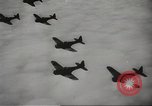
Japanese air attack over U.S. naval air station in Kaneohe Bay, Honolulu during Pearl Harbor Raid of World War II.
A film dramatizes the Japanese air attack on Pearl Harbor in Honolulu, Hawaii during World War II. A formation of Japanese bombers drop bombs on Wheeler Army Airfield in Honolulu during Pearl Harbor attack. The bombs explode on parked U.S. aircraft and army installations on the airfield. Smoke billows up from the explosions. U.S. soldiers fire machine guns towards the Japanese bombers. U.S. pilots start to board aircraft. Japanese air attack on U.S. naval air station at Kaneohe Bay, Honolulu. Bombs explode. The bombs start to explode around U.S. sailors attending a church services. U.S. troops fire guns toward Japanese aircraft. They run around on the air field while Japanese aircraft continue attacks. U.S. pilots board the aircraft. Hangers in flames. U.S. soldiers remove bombs mounted under the wing of an aircraft.
CRITICALPAST.COM: About Us | Contact Us | FAQs - How to Order | License Agreement | My Account | My Lightboxes | Shopping Cart | Advanced Search | Featured Collections | Website Terms & Conditions | Privacy Policy ©2026 CriticalPast LLC.
License Agreement |
Terms & Conditions |
Privacy Policy
©2026 CriticalPast LLC.