


 Francais
 Deutsch
 Italiano
Refine Your Search
V2 stock footage and images
- Showing 7015 to 7020 of 9941 results more
more Hide
Hide
Allied forces attack German-occupied Ortona, and San Pietro in Italy during World War II
Opening scene shows British artillerymen bombarding the Italian town of Ortona, on the Adriatic coast of Italy, which is held by paratroops of the German 1st Parachute Division in World War 2. Closeups of British soldier operating 155mm gun. British officers planning the barrage. Battery of guns firing. View of shells striking Ortona, along the coastline. Heavy guns firing from under camouflage netting. Smoke rising from artillery strikes. Scene shifts to Allied occupied airfield in Foggia, on the coast, South of Ortona, where P-40 aircraft of the 99th Pursuit Squadron are preparing to fly in support of the Ortona offensive. (This U.S Army Air Forces unit is comprised entirely of African American pilots and support personnel including Tuskegee Airmen.) Closeups of airmen fueling and arming the aircraft, and of pilots gathered in a mission briefing. 99th Squadron aircraft taking off and departing overhead in formations. View from the British artillery position of numerous bombs bursting on Ortona. Film shifts to the Central Front in Italy where U.S. forces are engaged in the Battle of San Pietro. Views of American artillery bombarding German positions in San Pietro. Closeups of numerous U.S. guns being fired. An ejected shell flies through the air from a U.S. Sherman tank during the bombardment. Views of U.S. troops passing a Sherman tank as they enter San Pietro and begin searching for booby traps in the wreckage of the town. Closeup of a soldier dismantling a booby trap. German aircraft sweep overhead and bomb the town. American soldiers dig out a buddy who was buried by a bomb burst, but rescued unhurt. He smiles for the camera. Casualties of the fighting, including many civilians are carried on stretchers and assisted. Local residents are seen grieving over fallen relatives and friends. Groups of townspeople stand along a hillside and watch as Italian soldiers join with the Allies in the fighting. Jeeps are seen navigating the muddy mountain trails as far as possible. Then further movement requires the use of mules. Troops are seen with mule trains. Soldiers shoulder heavy ammunition crates and slog uphill with them over a muddy mountain trail.
Battle for Okinawa in World War II
U.S. infantry and M4 Sherman tanks move against heavily fortified Japanese positions on Okinawa during World War 2. American soldiers use flame throwers to dislodge Japanese defenders. Two soldiers run as an explosion occurs behind them. U.S. artillery firing from under camouflage netting. Glimpse of soldier walking past a burning building. Okinawan women and children seek refuge behind the U.S.Tenth Army lines. A soldier carries a naked baby to safety. View of Okinawan refugees (Ryukyuan people), mostly women and children and some old people, seated together where they are to be cared for by the Army's Civil Affairs Command. Wounded American soldiers being placed aboard a U.S. Air Transport Command C-47 aircraft number 42-72383. Change of scene to the battlefield where a U.S. Army soldiers throw a hand grenades that explode on a Japanese caves. A Japanese soldier is shot as he stumbles out of his cave. Another Japanese soldier is take prisoner. U.S. soldier fires his rifle and a Japanese soldier falls to the ground. Scenes shift to the sea off of Okinawa, where a Benson-Livermore class destroyer is seen under a sky full of black flak clouds. Closeup of the destroyer. A Japanese aircraft is shot down as it flies toward a U.S. New Orleans class heavy cruiser. It crashes into the sea near another U.S. capital ship. An attacking Japanese plane is shot down by anti-aircraft fire and crashes into the sea. More flak filled skies and bombs exploding along with machine gun fire raking the waters. Anti-aircraft tracer bullets firing from ships. A Japanese plane hit, is burning, and then explodes in the air. A Douglas dauntless aircraft lands on an aircraft carrier. Another aircraft doesn't make it to the carrier, and ditches in the water nearby. The pilot is seen standing on the plane's right wing, awaiting pick up. A Navy F4U Corsair plane approaches its carrier to land but loses control and crashes into the carrier's island. Firefighters direct streams of water on it's burning wreckage.
South African and New Zealand troops occupy Florence in Italy.
Mop up operation by British Allied forces in Florence, Italy, during World War 2. South African and New Zealand troops advance on tanks. Soldier looks through binoculars. Views of city of Florence including Florence Cathedral (Duomo). View of Ponte Vecchio bridge in the city, the only one spared by the German forces who destroyed all other bridges over the Arno River at Florence. Soldier fires from the hidden area. Explosions in the city. Soldiers patrol on streets of Florence. Civilians on streets, including some partisan civilian soldiers aiding in the elimination of German sniper positions.

French civilians welcome United States troops in Rennes, France.
United States troops enter Rennes, France during World War 2. Sign board reads 'Rennes Centre Autres directions and Chateubriant Angers'. Soldiers enter town with tanks and artillery. French civilians welcome the United States soldiers. The Rennes City Hall (Place de la Mairie, Rennes) from the side of the Rue de l’Horloge displays the flags of France, the United States, and the United Kingdom. Prisoners move raising their hands. Women and children dance on street. French men and women wave heir hats and flags of the United States as military vehicles drive by. People cheering near the Dressoir shop on the Rue d l’Horloge. Captured German soldiers being made to march after their surrender. A group of United States soldiers restrain an outraged French man from attacking captured German prisoners. German prisoners sitting. French women Nazi collaborators raise their hands up and leave the Cinéma Royal (Place du Calvaire, Rennes) after their surrender, with crowds booing at the women. Angry French man in the crowd. Angry French mob tries to attack an apprehended militia chief, only to be restrained by soldiers. French women and men holding their hands dancing. Crowds outside the Café Poncel (4 rue de Coëtquen, Rennes, France).
Pope Pius XII and the civilians welcome the Allied forces in Rome, Italy.
German soldiers retreating and exiting from Rome in the final hours of their occupation during World War 2, before arrival of U.S. forces. German soldiers on foot, and loaded on mechanized vehicles and bicycle, leaving the city before its liberation. View of United States 5th Army forces as they enter Rome during World War II. U.S. Army soldiers entering the city with M4 Sherman tanks. Troops marching in front of the Archbasilica of Saint John Lateran (Piazza di S. Giovanni in Laterano, 4, 00184 Roma RM, Italy) and the Roman Colosseum (Piazza del Colosseo, 1, 00184 Roma RM, Italy). Porta San Giovanni near the Archbasilica of Saint John Lateran. Italian women shake hands with Allied troops during a parade. Italian civilians running, possibly from sniper attack. Allied troops fire Browning M1919 machine guns at German snipers hiding from a building. A German soldier waves a white flag from a balcony. Pope Pius XII welcomes British troops inside the Vatican City. Pope Pius XII blesses the troops while being carried on a sedia gestatoria chair. Italian women inspect graves of 320 massacred civilians in the catacombs. A sign gives notice of site where Italian civilians were massacred by German troops. British and Indian troops march towards Montone, pursuing the retreating German forces, despite German counter-attack fire. Field guns fired, tanks advancing. British Infantry and Indian infantry soldiers move on streets.
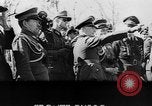
Japanese and Turkish military missions tour Eastern Front at German invitation, in World War II
Opening scene shows German Field Marshal Wilhelm Keitel gesturing as he hosts members of a Japanese military mission and a Turkish military delegation (headed by Colonel General Cemil Cahit Toydemir). At Adolf Hitler's invitation, they are on a tour of the Eastern front and English channel coasts between June 25th and July 7th, 1943, during World War 2. Here, they are seen inspecting German positions and witnessing firepower demonstration on the Russian Front near Kharkov (also Kharkiv) just south of Kursk. They observe a German artillery gun crew as they demonstrate rapid firing of their field piece. Shells explode raising black smoke. Closeup of a senior Japanese military official. Turkish and Japanese delegation visitors board two small open train cars driven by German soldiers on motorcycles adapted for the purpose. Following a pause, the scene shifts to the visiting officers inspecting German armor, including a small armored personnel carrier; a Tiger Tank of Pz.Abt.503; and other armored vehicles. They watch a Tiger tank moving along a muddy berm rotating its turret and 88mm gun as it moves. Another tank races past the camera at high speed, raising clouds of dust. A German gun crew, in a trench, fires an MG 42 heavy machine gun. They look up and camera focuses on formations of German JU 87 Stuka dive bombers flying overhead. Visiting officer peers through a periscopic viewing device, as Large explosion occurs in the field. German, Japanese, and Turkish officers converse as a huge plume of smoke rises in the background, capturing their attention.
CRITICALPAST.COM: About Us | Contact Us | FAQs - How to Order | License Agreement | My Account | My Lightboxes | Shopping Cart | Advanced Search | Featured Collections | Website Terms & Conditions | Privacy Policy ©2026 CriticalPast LLC.
License Agreement |
Terms & Conditions |
Privacy Policy
©2026 CriticalPast LLC.